Engineered Panspermia as Technosignature: A Framework for Detecting Deliberate Galactic Seeding
Abstract
The hypothesis that an advanced extraterrestrial civilization could have deliberately seeded the galaxy with self-replicating chemical systems — a form of directed panspermia — remains largely unexplored as a technosignature research program. This paper proposes a plausible engineering architecture for such a seeding system, develops a suite of detection strategies spanning remote observation, in-situ analysis, and comparative biochemistry, and examines recent findings from NASA’s Curiosity rover in Gale Crater as a case study. In particular, the 2025–2026 discovery of long-chain alkanes in the Cumberland mudstone — at abundances that known abiotic processes cannot readily explain — represents the type of anomaly that a directed panspermia detection framework would flag for further investigation. We argue that this line of inquiry deserves formal inclusion in the technosignature research portfolio, as it is testable with current and near-future instrumentation, and its predictions are distinct from those of both independent abiogenesis and natural panspermia.
1. Introduction
The search for extraterrestrial intelligence (SETI) has historically focused on electromagnetic signals — radio transmissions, laser pulses, and other deliberate communications. In recent years, the field has expanded to include a broader class of technosignatures: observable indicators of technology, whether or not they were intended as communication. Dyson spheres, atmospheric industrial pollutants, and megastructure transit signatures have all been proposed as targets of observation.
One category of technosignature, however, remains surprisingly underexplored: the deliberate seeding of life itself. If an advanced civilization sought to propagate biology across the galaxy, the resulting biospheres — and the chemical precursors that initiated them — would constitute detectable artifacts of technological activity. Unlike a radio beacon, which requires continuous operation, a seeding program produces signatures that persist for billions of years and grow more detectable over time as biology takes hold and transforms planetary environments.
This paper develops three interconnected arguments. First, that a plausible and physically realizable engineering architecture exists for galactic-scale biological seeding. Second, that specific, testable detection strategies can be derived from this architecture. Third, that recent discoveries on Mars — particularly the anomalous abundance of long-chain organic molecules in ancient lacustrine sediments — are consistent with (though not proof of) the predictions such a framework generates.
2. The Engineering Problem: Seeding a Galaxy
2.1 The Core Challenge
An advanced civilization attempting to seed the galaxy with life faces a formidable optimization problem. The Milky Way spans approximately 100,000 light-years, contains hundreds of billions of star systems, and presents overwhelmingly hostile environments for biology. Any seeding payload must survive millions of years of interstellar transit under constant cosmic ray bombardment, arrive at a target world intact, and bootstrap a living system in an environment that could not have been predicted in detail at the time of launch.
This is not a problem that admits a single elegant solution. Rather, it defines a design space bounded by trade-offs between coverage and precision, simplicity and robustness, cost per unit and total system effectiveness.
2.2 The Spectrum of Approaches
Shotgun seeding represents the brute-force end of the spectrum. In this model, trillions of small payloads — RNA or pre-RNA precursors embedded in mineral matrices, each a few hundred microns across — are accelerated outward using radiation pressure or laser arrays. This approach maximizes coverage and minimizes per-unit complexity. However, it suffers from critical weaknesses: naked RNA degrades under cosmic ray exposure over million-year timescales, targeting is nonexistent, and most payloads are wasted on gas giants, dead rocks, or the interstellar void.
Von Neumann probe delivery occupies the opposite extreme. Self-replicating probes travel to candidate systems, survey them, and deliver tailored biological payloads to promising worlds. This is maximally efficient per delivery but astronomically expensive per unit, slow to scale, and arguably harder to engineer than the biological payload itself — the probes must survive and function after interstellar transit with no possibility of repair.
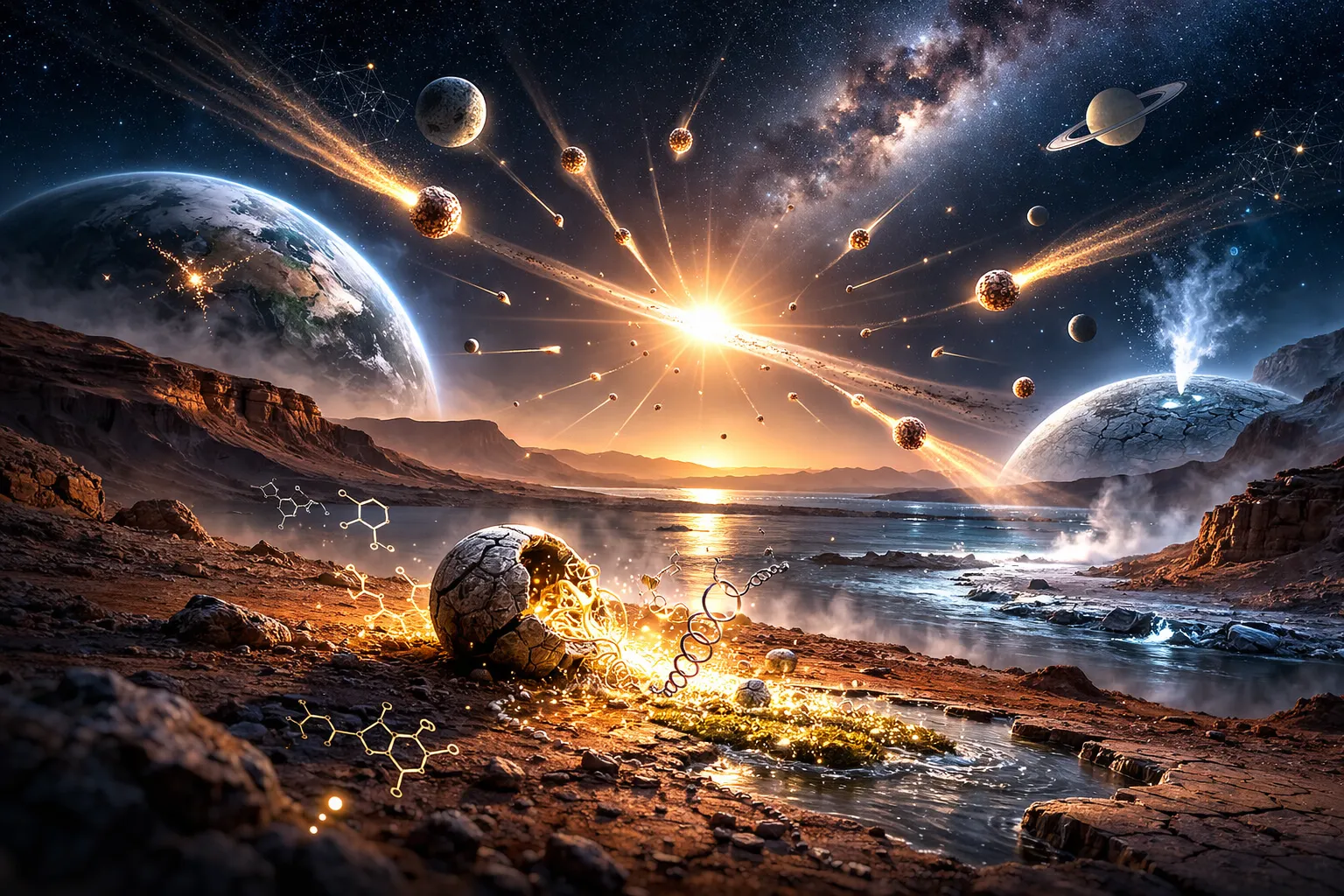
2.3 A Plausible Architecture: Autonomous Seed Packages
A sophisticated civilization would likely converge on an intermediate design — one we term autonomous, self-replicating seed packages with passive environmental sensing. The key components are:
The vehicle: a shielded micro-capsule (1–10 mm scale). The outer shell is a radiation-hardened mineral or ceramic matrix, analogous to a synthetic chondrule. This provides passive UV and moderate cosmic ray shielding, and is engineered to survive atmospheric entry via controlled ablation, mimicking the natural survival of micrometeorites. Billions of natural particles in this size regime survive entry to Earth’s surface annually, establishing the physical feasibility of this approach.
The cargo: a prebiotic chemistry kit, not finished RNA. This is the critical design insight. Sending intact RNA molecules across interstellar distances is impractical due to radiation-induced degradation. Instead, the capsule carries a carefully designed mixture of precursor molecules, catalytic mineral surfaces, and compartmentalization agents (such as lipid vesicle precursors). When activated by liquid water, this mixture spontaneously generates self-replicating RNA-like polymers through well-characterized prebiotic chemistry pathways. The civilization would engineer the precursor mix so that the outcome is robust — not dependent on one specific sequence, but on a class of self-replicating chemistries that reliably emerge from the starting conditions. This is sending a recipe rather than a finished dish.
The trigger: water-activated with environmental gating. The capsule’s shell is designed to be inert in vacuum and dry conditions but to dissolve or become permeable when immersed in liquid water within a target temperature and pH range. This provides an automatic environmental filter — the payload activates only on worlds with liquid water and reasonable chemistry. Layered shell design can require prolonged water exposure (weeks to months) for full permeability, filtering out transient water events. No onboard computer, power source, or active sensing is required — only clever materials science.
The replication strategy: seeding evolution, not organisms. The precursor mix does not generate a single replicator. It generates a population of variant replicators competing for resources in the local chemical environment. The civilization is not seeding life — it is seeding Darwinian evolution. The specific organisms that eventually arise will be locally adapted and unpredictable. The design ensures only that the critical transition from chemistry to natural selection — arguably the hardest step in abiogenesis — occurs reliably.
The delivery: stellar flyby dispersal. Rather than aiming at specific planets (which requires impractical precision over interstellar distances), swarms of millions of capsules are launched on trajectories passing through target star systems. Gravitational capture and interaction with dust, debris, and planetary atmospheres naturally deliver a statistical fraction to planetary surfaces. Propulsion is provided by stellar-powered laser arrays; at 0.01c, the galaxy is crossed in approximately 10 million years. Capsules are purely passive during transit — no moving parts, no electronics, no power systems to fail.
The economics: embarrassingly parallel. A Kardashev Type II civilization harnessing a fraction of its star’s energy output could, over centuries of operation, launch enough capsules to seed every star system in the galaxy multiple times over. The per-unit cost is negligible (milligrams of material, a brief pulse of laser energy), and the system is massively parallelizable.
2.4 Why This Architecture Is Compelling
This design is robust to ignorance. The seeding civilization does not need detailed knowledge of target worlds, faster-than-light travel, artificial general intelligence, or exotic physics. The required capabilities — excellent prebiotic chemistry, advanced materials science, and a large laser array — are plausible extensions of technologies we can partially demonstrate today.
The architecture also generates a distinctive prediction: life across the galaxy should share deep chemical homologies — similar chirality, similar nucleotide-like monomers, similar membrane chemistry — not due to convergent evolution, but because it all emerged from the same precursor kit. Surface-level biology would diverge wildly, but the deep biochemistry would rhyme.
3. Detection Strategies
3.1 Remote and Telescopic Methods
Anomalous spectral signatures in cometary and asteroidal debris. If seeding swarms passed through our solar system, some capsules would have been captured into orbits or embedded in comets and asteroids. When comets outgas near the Sun, their released dust can be studied spectroscopically. Unusual organic signatures — molecular species inconsistent with standard astrochemical models, such as an unnatural enantiomeric excess or molecules with no known abiotic formation pathway — could indicate engineered origin.
Infrared survey of interstellar dust populations. Engineered ceramic shells may have distinctive emissivity profiles compared to natural silicate or carbonaceous grains. Large-scale infrared surveys (such as those from JWST or successor missions) could, in principle, detect a subpopulation of particles with anomalous thermal or spectral properties through statistical analysis of dust grain populations along different sightlines.
Transit and occultation signatures. Dense, coherent seeding swarms could produce faint, characteristic dimming patterns when passing between us and background stars. The artificially narrow particle size distribution (all capsules manufactured to similar specifications) would generate a distinctive wavelength-dependent extinction curve, different from natural dust clouds.
3.2 In-Situ Detection Within Our Solar System
Micrometeorite collection and re-examination. Micrometeorites are routinely collected from Antarctic ice and deep-sea sediments and studied under electron microscopy and mass spectrometry. If seeding capsules were designed to survive atmospheric entry, some should exist in current collections. The critical signature would be anomalous internal structure — a shell-and-payload architecture with organized compartmentalization, rather than the homogeneous or chondritic texture of natural particles. A targeted re-examination of existing collections with this specific question in mind could be conducted at minimal cost.
Isotopic ratios as a smoking gun. Every star system has a characteristic isotopic fingerprint (carbon-12/13, oxygen-16/18, nitrogen-14/15 ratios) set by its nucleosynthetic history. A micrometeorite with organic content bearing non-solar isotopic ratios is already identifiable as interstellar. If the isotopic ratios were internally inconsistent — the mineral shell matching one stellar source and the organic payload showing a different, perhaps biologically fractionated, pattern — this would be extremely difficult to explain through natural processes. Presolar grains found in meteorites demonstrate that such analysis is already technically feasible.
Sample return from comets and asteroids. Missions like OSIRIS-REx and Hayabusa2 have returned asteroidal samples. Future cometary sample return missions could deliberately target the search for anomalous particles, applying the full battery of laboratory analysis — electron microscopy, nanoscale mass spectrometry, synchrotron X-ray tomography — to map 3D internal structure at nanometer resolution and distinguish natural from engineered architecture.
Dedicated interstellar dust collection. Following the confirmed passage of interstellar objects through our solar system (e.g., ʻOumuamua), a mission positioned to collect fresh interstellar dust — perhaps stationed at the outer solar system beyond solar wind contamination — could capture unweathered interstellar grains for analysis. NASA’s Stardust mission demonstrated aerogel-based dust collection; a next-generation instrument optimized for interstellar particles could be transformative.
3.3 Biochemical and Comparative Methods
Cross-comparing independent origins of life. If life is discovered on Mars, Europa, Enceladus, or Titan, the pivotal question is whether it shares deep biochemistry with Earth life. Shared chirality, nucleotide bases, and core metabolic logic — in organisms that clearly diverged billions of years ago — would be very difficult to explain by coincidence or contamination. It would strongly suggest common origin, consistent with both natural and directed panspermia. Conversely, completely alien biochemistry would argue against the seeding hypothesis for that world.
Detecting “too-easy” abiogenesis. Life on Earth appeared remarkably rapidly — possibly within a few hundred million years of the planet becoming habitable. If life arises quickly on every habitable world we examine, this could indicate that abiogenesis is inherently easy, or that someone provided a running start. Distinguishing these scenarios requires deep understanding of prebiotic chemistry and whether Earth’s specific pathway was the naturally favored one or an improbably efficient route.
4. Case Study: Anomalous Organics in Gale Crater
4.1 The Discovery
In 2025, Freissinet et al. reported the detection of long-chain alkanes — decane (C₁₀H₂₂), undecane (C₁₁H₂₄), and dodecane (C₁₂H₂₆) — in the Cumberland mudstone of Gale Crater, Mars. These are the largest discrete organic molecules identified on the Martian surface to date, detected by the Sample Analysis at Mars (SAM) instrument aboard the Curiosity rover. The team proposed that the alkanes were derived from thermal decarboxylation of fatty acids preserved in the mudstone.
4.2 The Abundance Problem
In a follow-up study published in February 2026 in Astrobiology, Pavlov et al. performed a critical re-analysis. The measured alkane concentrations of 30–50 parts per billion represent a lower limit, as the Cumberland mudstone has been exposed to ionizing radiation on the Martian surface for approximately 80 million years. Using laboratory radiolysis experiments and mathematical modeling, the authors estimated that the mudstone originally contained 120 to 7,700 parts per million of long-chain alkanes and/or their fatty acid precursors before radiation exposure.
The team then systematically evaluated known abiotic sources:
- Meteorites and interplanetary dust particles (IDPs): Estimated to account for approximately 0.1 ppb of alkanes — at least six orders of magnitude below the inferred pre-irradiation abundance. Additionally, IDPs and meteorites cannot penetrate lithified (hardened) sedimentary rock.
- Atmospheric organic haze deposition: Unlikely, as early Mars probably lacked the methane-rich conditions required for substantial haze production.
- Hydrothermal synthesis: While laboratory experiments confirm that long-chain organics can form hydrothermally, the mineralogy of the Cumberland mudstone indicates it did not experience the high temperatures associated with such reactions.
- Serpentinization: Examined and found insufficient to account for the observed abundances.
The authors concluded that the high inferred concentration of long-chain alkanes is inconsistent with known abiotic sources, leaving open two primary hypotheses: allochthonous delivery of hydrothermally synthesized organics from elsewhere on Mars, or the existence of an ancient Martian biosphere.
4.3 Relevance to the Seeding Framework
The Pavlov et al. findings align with predictions generated by the directed panspermia model in several specific ways:
Fatty acids as expected products. The alkanes are likely degradation products of long-chain fatty acids — the fundamental building blocks of cell membranes. In the seeding architecture described in Section 2, the precursor chemistry kit would be designed to generate lipid vesicles (proto-cell membranes) as a core component of the compartmentalization step. A bloom of fatty acid production, far exceeding meteoritic delivery capacity, is a direct prediction of the model.
The abundance gap. The six-order-of-magnitude discrepancy between observed organics and what abiotic delivery can explain is precisely the type of anomaly the seeding model predicts. Activated seed capsules would flood the local aqueous environment with membrane-forming molecules and replicator precursors at concentrations that local geology alone cannot produce.
The depositional environment. The Cumberland mudstone was deposited in a standing lake — an ancient lacustrine environment with sustained liquid water, clay-rich mineral surfaces, and fine-grained sediment. This is nearly the ideal activation environment for water-triggered seed capsules: liquid water provides the trigger, clay minerals offer catalytic surfaces, and fine sediment preserves the chemical products over geological time.
The even-carbon chain bias. Among the detected molecules, dodecane (C₁₂, even-chain) was the most abundant. On Earth, biological fatty acid synthesis via the acetyl-CoA pathway produces predominantly even-chain fatty acids by adding two carbons per cycle. Abiotic processes like Fischer-Tropsch synthesis produce smoother chain-length distributions without strong even/odd preference. An engineered chemistry kit designed to produce membrane-forming lipids would likely employ a similar two-carbon addition pathway, as it is the most chemically efficient route to functional membranes.
4.4 Discriminating Between Hypotheses
It is essential to note that the current data cannot distinguish between three compatible explanations: (1) Mars developed an indigenous biosphere independently, (2) Mars received life via natural panspermia from Earth or vice versa, or (3) both Mars and Earth were seeded by a common directed panspermia event. The organic anomaly is consistent with all three biological hypotheses and inconsistent only with purely abiotic explanations.
Discriminating between these scenarios requires deeper biochemical analysis — specifically, the molecular-level characterization that Mars Sample Return could provide. If Martian organic matter reveals the same chirality, similar nucleotide-like chemistry, and analogous metabolic architecture to Earth life, the independent-origin hypothesis becomes difficult to sustain, and some form of common origin (natural or directed) gains support. If it reveals entirely alien biochemistry, independent origin is favored and the directed seeding hypothesis is weakened for Mars specifically (though not globally).
5. A Proposed Research Program
Based on the preceding analysis, we propose a phased technosignature research program:
Phase 1: Immediate (Current Resources)
- Systematic re-examination of existing micrometeorite collections from Antarctic ice and deep-sea sediments, specifically searching for anomalous internal shell-and-payload architecture, non-solar isotopic signatures in organic-bearing grains, and internally inconsistent isotopic ratios between mineral and organic components.
- Formal inclusion of the seeding hypothesis in the analytical framework for Mars Sample Return science planning, ensuring that sample selection and analysis protocols are designed to test for biochemical commonalities with Earth life at the molecular level.
- Theoretical modeling of precursor chemistry kit design, establishing what molecular signatures (abundance ratios, chain-length distributions, chirality patterns) would distinguish an engineered prebiotic system from natural abiotic chemistry.
Phase 2: Near-Term (Next-Generation Missions)
- Cometary sample return missions targeting long-period comets (which are more likely to have captured interstellar material) with instrumentation optimized for detecting anomalous organic-bearing particles.
- Dedicated interstellar dust collection missions, building on the Stardust heritage, positioned beyond the heliosphere to capture uncontaminated interstellar grains.
- Biochemical comparison of any extraterrestrial life discovered within our solar system (Mars, Europa, Enceladus) with Earth life, specifically testing for shared deep biochemical architecture.
Phase 3: Long-Term (Future Capabilities)
- Statistical analysis of exoplanetary biosignatures across different stellar environments, testing whether the distribution of inhabited worlds is consistent with a seeding model (clustered along plausible dispersal trajectories) or random (consistent with independent abiogenesis).
- Infrared characterization of interstellar dust populations with next-generation space telescopes, searching for artificial subpopulations with anomalous spectral properties.
6. Conclusion
The hypothesis of directed panspermia — that an advanced civilization deliberately seeded the galaxy with self-replicating chemical systems — is physically plausible, engineeringly feasible, and scientifically testable. The architecture we describe requires no exotic physics, only excellent prebiotic chemistry, advanced materials science, and stellar-scale energy infrastructure. Its predictions are specific and distinguishable from both independent abiogenesis and natural panspermia.
The recent discovery of anomalous long-chain organic molecules in Martian mudstone — at abundances that known abiotic processes cannot explain — represents exactly the type of observation that this framework is designed to flag. While the data are far from conclusive, they illustrate that directed panspermia is not merely philosophical speculation but a hypothesis that intersects with active, data-rich research programs in planetary science and astrobiology.
The detection strategies we propose range from essentially zero-cost (re-examining existing micrometeorite collections) to mission-scale (dedicated interstellar dust collectors), providing entry points at every level of investment. We argue that directed panspermia detection deserves formal recognition as a technosignature research line — not because we believe it is likely, but because it is testable, because its predictions are specific, and because the evidence needed to evaluate it is increasingly within reach.
If the seeds are out there, some of them may already be in our laboratories. We need only know what to look for.
References
-
Freissinet, C., Glavin, D. P., Archer, P. D., et al. (2025). Long-chain alkanes preserved in a Martian mudstone. Proceedings of the National Academy of Sciences, 122(13), e2420580122.
-
Pavlov, A. A., Freissinet, C., Glavin, D. P., et al. (2026). Does the Measured Abundance Suggest a Biological Origin for the Ancient Alkanes Preserved in a Martian Mudstone? Astrobiology. DOI: 10.1177/15311074261417879.
-
Eigenbrode, J. L., et al. (2018). Organic matter preserved in 3-billion-year-old mudstones at Gale crater, Mars. Science, 360, 1096–1100.
-
Crick, F. H. C. & Orgel, L. E. (1973). Directed Panspermia. Icarus, 19, 341–346.
-
Arrhenius, S. (1908). Worlds in the Making. Harper & Brothers.
-
Wickramasinghe, C. (2010). The astrobiological case for our cosmic ancestry. International Journal of Astrobiology, 9(2), 119–129.
-
Lingam, M. & Loeb, A. (2019). Life in the Cosmos: From Biosignatures to Technosignatures. Harvard University Press.
This whitepaper is intended to stimulate discussion and further research. The authors do not claim that directed panspermia has occurred, only that it is a testable hypothesis deserving of systematic investigation within the broader technosignature research program.
This article represents my personal opinions and research. Nothing in this article should be taken as professional, financial, legal, or investment advice.