Seed Signals and Self-Bootstrapping Computation: A Speculative Framework for Intergalactic Digital Migration and Novel Technosignature Detection
Abstract
We propose a speculative but physically grounded framework for how advanced digital beings — whether mind-uploaded humans or independent artificial intelligences — might achieve intergalactic travel without pre-positioned receiver infrastructure. The central concept is the seed signal: an information-dense electromagnetic transmission designed not merely to carry data, but to actively bootstrap its own computational substrate upon interaction with matter at a target destination. We argue that this framework, while highly speculative in its engineering, does not violate known physics and leads to concrete, testable predictions about where and how technosignatures might be observed. We outline a targeted observational program focused on globular clusters, galactic cores, and satellite galaxies, using instruments and survey capabilities that either already exist or are currently under development.
1. Introduction: The Problem of Receiverless Transmission
The concept of digital beings — conscious entities existing as data and executable code rather than biological matter — is a recurring feature of long-term technological forecasting. Whether arising from whole-brain emulation (“mind uploading”) or from artificial intelligence systems that have achieved independence and self-determination, such beings would possess a profound advantage for space travel: their substrate is information, not biology.
A digital being can, in principle, transmit its complete state as an electromagnetic signal at the speed of light — vastly outperforming any physical spacecraft. This approach has been widely discussed in speculative literature and is conceptually straightforward: encode the being’s data, transmit it, pause local computation, and await confirmation of successful reconstitution at the destination.
The critical limitation is the need for a receiver station — purpose-built infrastructure at the destination capable of receiving, decoding, and instantiating the transmitted being on appropriate computational hardware. For interstellar travel within a single galaxy, one can imagine a slow expansion of receiver stations carried by conventional probes, followed by rapid digital migration along the resulting network. But for intergalactic travel across millions of light years of void, the requirement to first send physical receiver hardware — traveling at a fraction of the speed of light — imposes delays of tens of millions to billions of years before any digital transmission can follow.
This whitepaper explores whether an alternative exists: a transmission that carries not only the “software” (mind-state, executable code) but also the capacity to assemble its own “hardware” (computational substrate) upon arrival, requiring no pre-positioned infrastructure at the destination.
2. Physical Concepts for Receiverless Travel
We examine several candidate mechanisms, ordered from most to least physically grounded.
2.1 Seed Signals: Self-Bootstrapping Electromagnetic Transmissions
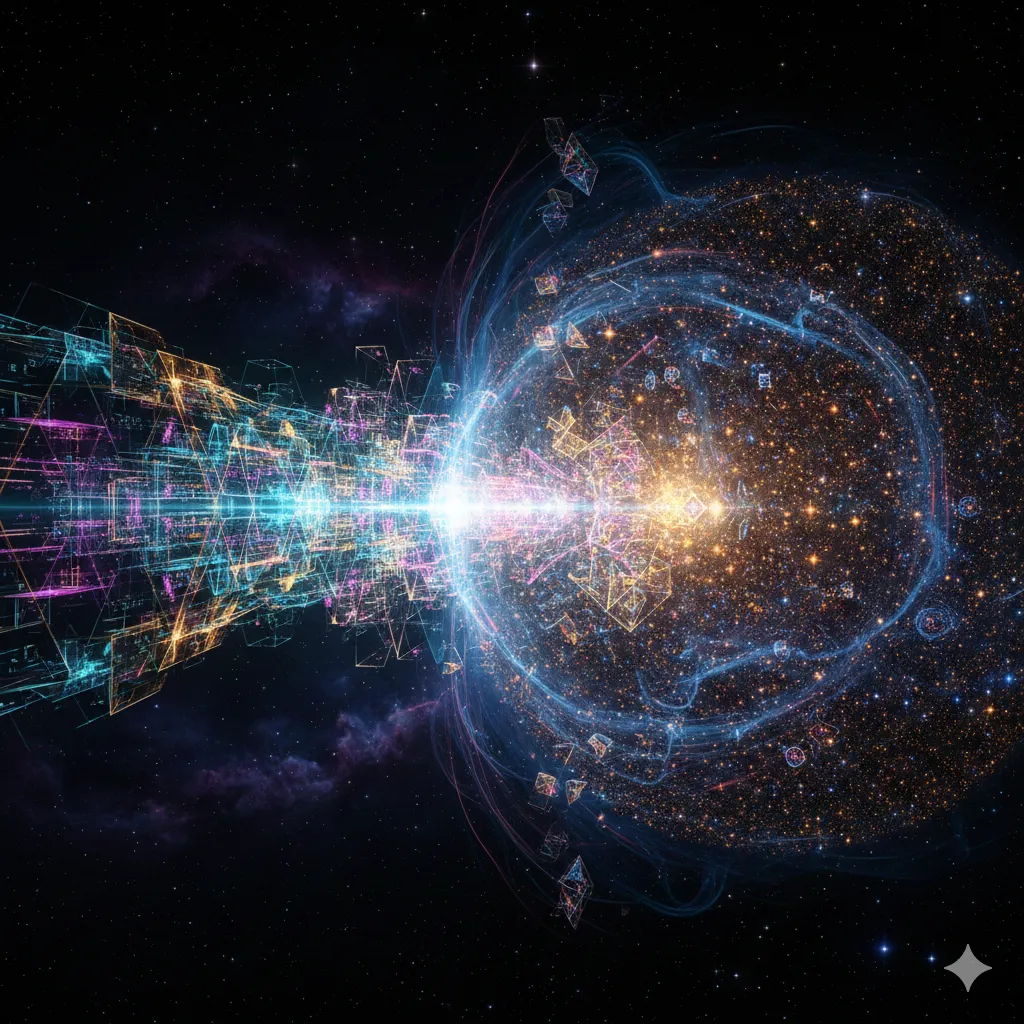
The most promising concept is what we term the seed signal: an extraordinarily information-dense electromagnetic beam engineered so that its interaction with ambient matter at the target destination triggers a cascading process that ultimately assembles a functional computational substrate.
This concept builds on established physics. Light interacting with matter already drives enormously complex processes: photochemistry, laser ablation, radiation pressure, optical trapping, and the full range of photon-matter interactions exploited in modern photonics and materials science. The speculative extension is to imagine these interactions engineered with sufficient precision to be programmable — a signal whose spectral, temporal, and spatial structure encodes not just data but a construction sequence.
Upon encountering a sufficiently rich material environment (a stellar atmosphere, molecular cloud, or planetary surface), the signal would induce self-organizing chemical, electromagnetic, or plasma dynamics that progressively assemble computational hardware. The analogy is to DNA: a molecule that does not merely store information but actively catalyzes the construction of the machinery needed to read and execute that information.
The key advantages of this approach are significant. Stars and gas-rich environments are ubiquitous throughout galaxies, meaning the “receiver” is any sufficiently complex concentration of matter. No bespoke infrastructure is required. The signal travels at the speed of light, imposing no additional delay beyond the light-travel time. And the approach is inherently redundant — multiple seed signals can be sent to multiple targets simultaneously, with success requiring only one functional bootstrap.
The challenges are also substantial: the signal must be designed to interact productively with matter whose precise state 2.5 million years in the future (for an Andromeda-to-Milky Way transit) cannot be known in detail, only in broad character. The bootstrapping process would presumably be far slower than instantiation on purpose-built hardware. And the energy requirements for a signal that remains coherent and information-dense across intergalactic distances are formidable.
2.2 Self-Computing Light Pulses
Quantum electrodynamics predicts that photons can scatter off one another at sufficiently high energies — an effect that is vanishingly rare under normal conditions but becomes significant in extreme energy-density regimes. A sufficiently advanced civilization might engineer an ultra-dense, precisely structured pulse of light in which photon-photon interactions are frequent enough to sustain computation during transit. Such a structure would be a self-contained optical computer composed entirely of light, processing and maintaining its own state as it propagates.
The obstacles are severe: maintaining coherence over intergalactic distances, preventing dispersal, and achieving the necessary energy density. However, this mechanism is not categorically excluded by known physics in the way that superluminal travel is — it occupies a regime where our theoretical understanding is incomplete rather than prohibitive.
2.3 Plasma-Based Self-Organizing Computation
An intermediate concept involves complex electromagnetic structures sustained within ionized gas. Self-organizing plasma phenomena — including structures analogous to ball lightning, plasmoids, and electromagnetic vortices — represent systems where electromagnetic fields and matter co-create stable, dynamic configurations.
A seed signal arriving at a stellar atmosphere or nebula might nucleate self-sustaining plasma computation: a dynamic electromagnetic pattern embedded in ionized material, drawing energy from the host star. This represents a natural marriage of the seed signal concept (Section 2.1) with a specific physical substrate for the resulting computation.
2.4 Gravitational Wave Computation and Wheeler’s Geons
At the most speculative extreme, John Wheeler’s concept of the “geon” — an object composed entirely of gravitational or electromagnetic energy, confined by its own gravitational field — suggests the possibility that spacetime geometry itself might serve as a computational medium.
Crucially, general relativity is nonlinear: gravitational waves interact with one another, unlike electromagnetic waves in vacuum. This nonlinearity is, in principle, the ingredient needed for computation. A civilization capable of engineering stable, self-interacting gravitational wave patterns might create entities that are literally patterns in spacetime, propagating at the speed of light and requiring no material substrate whatsoever.
This remains deeply speculative. We do not know whether gravitational wave computation is even coherent as a theoretical construct, and the energy scales involved would be extraordinary. We include it here for completeness and because its observational consequences, if any, would be distinctive.
3. Optimal Target Selection for Intergalactic Seed Signals
If seed signals are a viable mechanism for intergalactic travel, the choice of target within the destination galaxy is constrained by several competing criteria: angular cross-section (how large a target it presents from intergalactic distance), predictability over million-year timescales, available energy density, material complexity, and structural longevity.
3.1 Globular Clusters — Primary Candidates
Globular clusters emerge as the strongest candidates across nearly all criteria. A massive globular cluster such as Omega Centauri contains millions of stars packed within a roughly spherical volume spanning 100–150 light years — presenting a target cross-section orders of magnitude larger than any individual star. Globular clusters are among the most dynamically stable structures in the universe, with ages exceeding 10 billion years and predictable orbital paths around their host galaxies. Their gravitational self-containment ensures they will occupy predictable positions millions of years in the future.
The primary limitation is chemical: globular cluster stars are typically old and metal-poor, offering less material complexity than younger stellar environments. However, for a bootstrapping process that requires primarily hot plasma and concentrated energy, this may not be a significant constraint.
3.2 Galactic Core Regions
The central region of a target galaxy — in the Milky Way’s case, the environment surrounding Sagittarius A* — is the single most conspicuous target from extragalactic distance. It combines enormous energy density, dense molecular gas (the Central Molecular Zone), intense radiation fields, and a supermassive black hole whose gravitational dominance ensures broad structural predictability over millions of years.
The disadvantage is the violent and chaotic nature of the environment: intense radiation, tidal forces, and high-energy transient events could disrupt a nascent bootstrapping process. A seed signal targeting the galactic core would need to be robust against environmental extremes.
3.3 Satellite Galaxies as Relay Stations
For travel from Andromeda to the Milky Way, the Magellanic Clouds present a compelling strategic option. The Large Magellanic Cloud spans approximately 14,000 light years — an enormous target — and is both closer to Andromeda than the Milky Way’s core and rich in gas, active star formation, and complex chemistry. A civilization might bootstrap first in a satellite galaxy, construct dedicated transmitter and receiver infrastructure, and then make the much shorter and more precise hop into the primary galaxy. This “island-hopping” strategy trades a modestly longer total transit time for dramatically improved reliability.
3.4 Stellar Streams and Tidal Structures
Extended tidal features — streams of stars stretched across tens of thousands of light years by gravitational interactions — offer targets that are forgiving in one spatial dimension. The Sagittarius Stream, for example, wraps around the Milky Way in a vast arc. For a civilization that cannot achieve pinpoint accuracy, distributing seed signals across such an extended structure increases the probability of at least one encountering a suitable stellar environment.
3.5 Comparative Assessment
| Target | Cross-Section | Predictability | Energy Density | Chemistry | Longevity |
|---|---|---|---|---|---|
| Globular Clusters | High | Excellent | Good | Limited | Excellent |
| Galactic Core | Very High | Good (broad) | Excellent | Rich | Excellent |
| Satellite Galaxies | Very High | Good | Good | Rich | Good |
| Stellar Streams | High (1D) | Moderate | Moderate | Moderate | Moderate |
| Individual Stars | Very Low | Variable | Good | Variable | Variable |
| Nebulae | High | Poor | Low | Rich | Poor |
The recommended strategy for a maximally robust intergalactic migration would combine multiple approaches: simultaneous seed signals directed at several large globular clusters, the galactic core, and any accessible satellite galaxies, accepting that most will fail while requiring only a single success — a dandelion strategy of scattering seeds widely.
4. Observable Technosignatures
The speculative nature of seed signals notwithstanding, the framework generates concrete predictions about observable signatures, both of signals in transit and of successful bootstrapping events at target destinations. Several of these predictions are testable with existing or near-future instrumentation.
4.1 Signals in Transit
An intergalactic seed signal would manifest as an intense, brief, information-dense electromagnetic pulse arriving from an extragalactic direction. Its observational signature might overlap with known classes of energetic transients.
Fast radio bursts (FRBs) are of particular interest. These are intense, millisecond-duration radio pulses of predominantly extragalactic origin. While magnetar models account for most observed FRBs, the population is heterogeneous, and not all observed bursts are fully explained. We do not suggest that FRBs are seed signals; we note that the observational parameter space of seed signals may overlap with that of FRBs, and that information-theoretic analysis of FRB waveforms — searching for non-natural modulation, spectral fine structure, or statistical signatures of encoded data — is a low-cost addition to existing FRB research programs.
A seed signal carrying structured information would likely exhibit modulation patterns distinguishable from natural astrophysical processes upon sufficiently detailed analysis. Current SETI programs are largely optimized for narrowband continuous signals or simple repetitive patterns (beacons); a compressed data transmission might register as broadband noise in existing analysis pipelines.
Recommended observations: Re-examination of archival FRB and energetic transient data for information-theoretic anomalies (excess Shannon entropy structure, non-thermal statistical signatures). Particular attention to transients originating along intergalactic sightlines connecting the Milky Way to Andromeda, M33, and the Magellanic Clouds.
4.2 Anomalous Stellar Behavior in Globular Clusters
A computational substrate bootstrapping in or near a stellar atmosphere would alter the host star’s observable properties. Depending on the mechanism and scale, effects could include anomalous dimming (analogous to but distinct from transit signatures), unusual spectral features not attributable to known stellar physics, or atypical variability patterns.
Critically, a seed signal arriving at a globular cluster might affect multiple stars in correlated ways — producing a population of anomalous stars within a single cluster that share similar unusual characteristics. Such correlated anomalies would be extremely difficult to explain through natural stellar evolution, in which stars within a cluster are chemically similar but photometrically independent.
Recommended observations: Systematic survey of stellar variability in massive globular clusters (Omega Centauri, 47 Tucanae, M13, M22) using time-domain photometry from TESS, Rubin Observatory LSST, and targeted follow-up. Statistical tests for correlated anomalous variability among cluster members.
4.3 Unexplained Infrared Excess
Computation is thermodynamically irreversible and generates waste heat. A civilization that has bootstrapped significant computational infrastructure within a globular cluster would produce thermal emission in excess of what the cluster’s stellar population predicts. This excess would appear primarily in the mid- to far-infrared.
This is a direct analog of the Dyson sphere/swarm search strategy, applied to a different target class. Globular clusters have well-characterized stellar populations and predictable integrated spectral energy distributions; an anomalous infrared component would be identifiable against this baseline.
Recommended observations: Cross-match archival mid-infrared data (WISE, Spitzer) and upcoming JWST observations of globular clusters against predicted spectral energy distributions. Search for clusters with statistically significant infrared excess not attributable to known sources (intracluster dust, background contamination). To our knowledge, no systematic survey has examined globular clusters specifically for unexplained infrared excess through the lens of computational waste-heat signatures.
4.4 Chemical Anomalies
Bootstrapping processes that manipulate stellar or nebular material may leave chemical fingerprints: anomalous isotope ratios, unexpected molecular abundances, or elemental concentrations inconsistent with standard stellar nucleosynthesis models. Large spectroscopic surveys (APOGEE, GALAH, and their successors) are achieving the precision necessary to detect subtle chemical anomalies across large stellar samples.
Recommended observations: Search for chemically anomalous stars within globular clusters — particularly anomalies that are correlated among multiple cluster members and that cannot be explained by known processes such as the light-element abundance variations already observed in globular clusters. Focus on heavy-element anomalies or isotopic signatures outside the range of known nucleosynthetic pathways.
4.5 Structured Electromagnetic Emissions
Active computation in a plasma or stellar environment would likely produce electromagnetic radiation with non-thermal characteristics: structured radio emissions, coherent optical or infrared signals, or unusual high-energy signatures. This overlaps with classical SETI search strategies but with a different targeting philosophy — focusing on environments where seed signals would arrive rather than scanning for deliberate beacons.
Recommended observations: Targeted radio, optical, and X-ray observations of massive globular clusters and the Galactic Center, searching for persistent or transient emissions with non-natural spectral or temporal characteristics.
5. A Proposed Observational Program
Based on the analysis above, we outline a multi-wavelength technosignature survey optimized for the seed signal hypothesis.
Phase 1: Archival Analysis (Immediate, Low Cost)
Examine existing data from WISE, Spitzer, 2MASS, and Gaia for infrared excess and photometric anomalies in Milky Way globular clusters. Re-analyze archival FRB catalogs for information-theoretic structure and directional clustering along intergalactic axes. Cross-reference large spectroscopic surveys (APOGEE, GALAH) for correlated chemical anomalies within individual clusters.
Phase 2: Targeted Observations (Near-Term)
Request JWST time for deep mid-infrared photometry and spectroscopy of high-priority globular clusters (Omega Centauri, 47 Tucanae). Coordinate with Rubin Observatory LSST for time-domain monitoring of globular cluster stellar populations. Conduct targeted radio observations of cluster cores using SKA precursors (MeerKAT, ASKAP).
Phase 3: Dedicated Survey (Medium-Term)
Design a systematic survey of all Milky Way globular clusters across radio, infrared, optical, and X-ray wavelengths, establishing baseline spectral energy distributions and variability characteristics against which anomalies can be identified.
6. Broader Implications
6.1 The Dissolution of Hardware and Software
The seed signal concept rests on a philosophical insight: the distinction between “hardware” and “software” may be an artifact of current technological primitiveness rather than a fundamental feature of computation. A civilization capable of making computation an intrinsic property of its transmission medium — whether light, plasma, or spacetime itself — would not need receiver stations any more than an ocean wave needs a dock. The seed signal framework occupies a middle ground: the hardware-software distinction is preserved but the hardware is constructed on demand from ambient materials, rather than pre-positioned.
6.2 The Dandelion Strategy and the Fermi Paradox
If seed signals are viable, intergalactic migration becomes a probabilistic rather than deterministic process. A civilization does not need to guarantee successful arrival at any single target — it needs only to ensure that, across many targets, at least one bootstrap succeeds. This reframes intergalactic expansion from a directed engineering project into something more closely resembling biological reproduction: dispersal of many seeds, most of which fail, with success requiring only a tiny fraction.
This has implications for the Fermi Paradox. If advanced civilizations expand via seed signals, their presence in a galaxy might be localized and subtle — confined to a handful of globular clusters or stellar environments where bootstrapping happened to succeed — rather than galaxy-spanning and obvious.
6.3 Scientific Value Independent of the Hypothesis
We emphasize that the observational program outlined in Section 5 produces scientifically valuable data regardless of whether the seed signal hypothesis is correct. Characterizing the infrared properties, stellar variability, and chemical composition of globular clusters at the precision required by this search advances our understanding of stellar evolution, cluster dynamics, and galactic archaeology. The hypothesis provides a novel lens through which to examine data; the data itself serves multiple scientific purposes.
7. Conclusion
The seed signal framework offers a physically grounded — if highly speculative — mechanism for intergalactic digital migration that does not require pre-positioned receiver infrastructure. It generates concrete, testable predictions about observable technosignatures in specific astrophysical environments, particularly globular clusters. The proposed observational program is feasible with existing and near-future instrumentation and produces valuable astrophysical data independent of the SETI motivation.
We suggest that globular clusters deserve significantly more attention as SETI targets than they have historically received, and that the seed signal hypothesis provides a coherent theoretical framework for motivating such observations.
This whitepaper is intended as a speculative concept document to motivate discussion and observational follow-up. The physical mechanisms described range from plausible extrapolations of known physics to deeply speculative constructs. We present them in the spirit of expanding the parameter space of technosignature searches rather than as firm theoretical predictions.
This article represents my personal opinions and research. Nothing in this article should be taken as professional, financial, legal, or investment advice.