The Lacework Survey: A Proposal for Detecting Galactic Wormhole Network Technosignatures Through Multi-Modal Anomaly Detection
Abstract
The search for extraterrestrial intelligence (SETI) has historically focused on intentional communication signals — radio beacons, laser pulses, and atmospheric biosignatures. We propose a complementary approach: searching for the structural signatures of large-scale spacetime engineering. Traversable wormholes, once purely theoretical, are now grounded in multiple frameworks within general relativity and quantum gravity. A sufficiently advanced civilization capable of constructing and networking such objects would leave observable imprints across gravitational, electromagnetic, and chemical channels. We identify six distinct technosignature classes that a galactic wormhole network would produce, map each to existing or imminent astronomical datasets, and outline machine learning pipelines capable of detecting them. Several of these searches can begin immediately using publicly available archival data from Gaia, WISE, 2MASS, OGLE, ZTF, and Breakthrough Listen, with dramatically expanded capability arriving via the Vera C. Rubin Observatory’s LSST, JWST archival mining, and the Nancy Grace Roman Space Telescope. This whitepaper is intended to garner interest in formalizing these searches into a coordinated, multi-institutional survey program — The Lacework Survey.
1. Motivation: Why Wormholes, Why Now?
1.1 The Theoretical Landscape Has Matured
Traversable wormholes are no longer science fiction curiosities. They are valid solutions to Einstein’s field equations, first rigorously formalized by Morris and Thorne (1988), who showed that a wormhole held open by exotic matter (material with negative energy density) permits causal transit between distant regions of spacetime. The central question has always been whether nature permits sufficient negative energy in one place to sustain such a structure.
Recent theoretical developments have substantially narrowed this gap:
The Gao-Jafferis-Wall construction (2016) demonstrated that in Anti-de Sitter spacetime, a wormhole can be rendered traversable not by bulk exotic matter but by a quantum coupling between the two mouths — a double-trace deformation that generates the necessary negative energy naturally through quantum effects. Maldacena, Stanford, and others extended this work to connect traversable wormholes to quantum teleportation via the ER=EPR conjecture, suggesting that entangled quantum systems are connected by microscopic wormhole geometries.
The Casimir effect — experimentally verified — demonstrates that quantum vacuum engineering can produce negative energy densities in the laboratory. While the magnitudes achievable today are vanishingly small, no known physical law prohibits scaling these effects, given sufficient technological mastery.
The implication is that a civilization with a mature understanding of quantum gravity — perhaps millions of years more advanced than our own — could in principle exploit these mechanisms at macroscopic scale. The question shifts from “are wormholes possible?” to “would we recognize one if we saw it?“
1.2 The Observational Window Is Opening
We are entering a golden age of time-domain, all-sky, multi-wavelength astronomy. The convergence of several major survey instruments — each generating data volumes that demand machine learning for analysis — creates an unprecedented opportunity for the kind of anomaly-driven search we propose:
- Gaia has catalogued precise positions, motions, and spectra for nearly two billion objects, including the first all-sky microlensing catalogue.
- WISE/NEOWISE provides mid-infrared photometry for hundreds of millions of sources, already being mined for Dyson sphere candidates.
- The Vera C. Rubin Observatory (LSST) began its decade-long survey in 2025, discovering millions of transients per night.
- JWST is actively characterizing exoplanet atmospheres and detecting mid-infrared sources at extraordinary sensitivity.
- The Nancy Grace Roman Space Telescope, launching circa 2027, will conduct high-cadence microlensing surveys of the galactic bulge.
- Breakthrough Listen is releasing open radio data from the Green Bank and Parkes telescopes.
The data is available or arriving. What is missing is a systematic framework for identifying wormhole-specific signatures within it.
1.3 The SETI Community Is Ready
The technosignature search paradigm has broadened considerably. NASA now formally recognizes technosignatures as a subset of the biosignature search program, and atmospheric, infrared, and structural technosignature searches can often be conducted as overlays on existing planetary characterization observations at no additional resource cost. Recent strategic papers have called for multi-node, networked sensing strategies capable of correlating multi-wavelength data in real time across instruments using AI-driven analysis — precisely the architecture our proposed survey would require.
2. The Target: Architecture of a Galactic Wormhole Network
To define what we’re looking for, we must first envision what we expect to find. The following design is speculative but physically grounded — each component maps onto real threads in current theoretical physics.
2.1 Construction Principles
A plausible wormhole generator — what we term a Throat Engine — would operate through several stages:
-
Vacuum Softening. A spherical array of field emitters, potentially hundreds of kilometers in diameter, manipulates the quantum vacuum to drive a localized region into a state of metastable topology, making spacetime “malleable.” At the Planck scale, spacetime is already a roiling foam of virtual wormholes; the machine selects and amplifies one of these pre-existing fluctuations.
-
Negative Energy Generation. The heart of the machine: a layered array of dynamically reconfigurable Casimir cavities constructed from Planck-scale metamaterials, generating coherent negative energy density — sculpted, dense sheets of it threaded into exact geometries. This operates on a principle of vacuum engineering: selective suppression of quantum field modes to sustain energy density below the vacuum baseline.
-
Throat Scaffolding. As the selected Planck-scale wormhole is amplified, a torus of exotic matter in magnetic and gravitational suspension is threaded into the nascent throat, serving the Morris-Thorne function of preventing collapse. This is a dynamic system, constantly adjusting its energy profile in response to real-time curvature tensor monitoring.
-
Entanglement Tethering. To render the wormhole traversable (per the Gao-Jafferis-Wall mechanism), a massive entanglement resource is shared between the two mouths. A continuous coupling signal maintained through ordinary spacetime generates the quantum stress-energy needed to keep the throat open to causal transit.
-
Mouth Stabilization. Stations the size of small moons at each end manage frame-dragging, tidal forces, and Hawking-like throat radiation, while serving as transition airlocks for traversing objects.
The critical constraint: the first wormhole between any two points requires light-speed setup of the entanglement tether through normal space. Once established, transit is nearly instantaneous — but the network frontier expands at c.
2.2 Network Topology
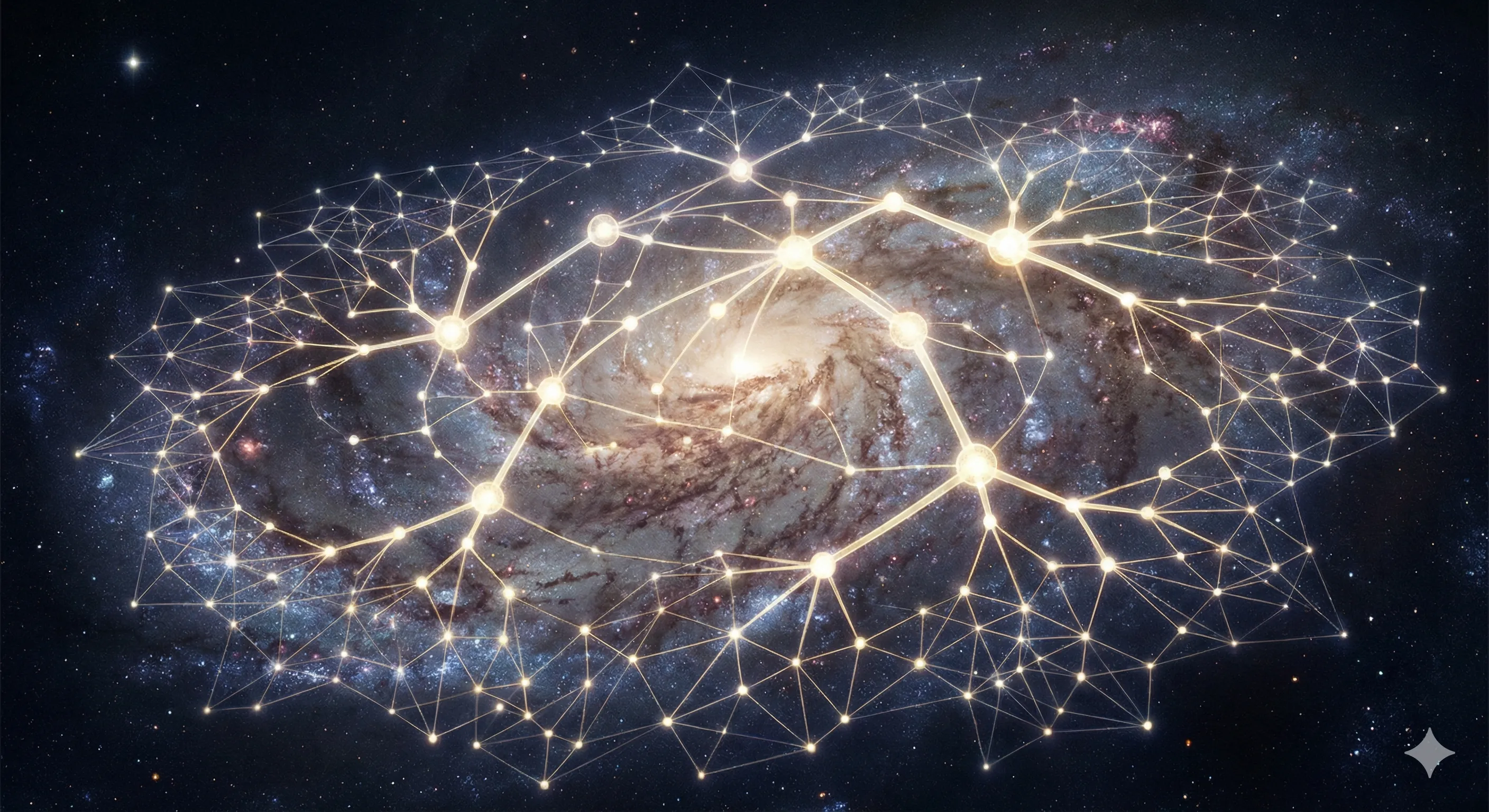
The most efficient and physically plausible network would be a hierarchical, scale-free graph — a topology observed in airline networks, neural systems, and the cosmic web of dark matter filaments:
Tier 1 — Trunk Lines. A small number (20–50) of major connections linking galactic regions. Mouths anchored near massive, stable stars for gravitational stability. Throats potentially kilometers in diameter, capable of passing entire fleets or vast quantities of energy and material.
Tier 2 — Regional Bridges. Dozens of connections per Trunk hub, linking individual star systems within a galactic arm or cluster. Hundreds of meters across, sufficient for large vessels and high-bandwidth information transfer. A typical spiral arm might have several hundred.
Tier 3 — Local Capillaries. The finest mesh, connecting individual systems or planetary orbits. Meters across — enough for personnel, data, and small cargo. Thousands per mature region.
This topology minimizes average path length while managing construction costs. Any two points in the galaxy might be reachable in 4–8 hops. The network’s interior functions as a single locality, even as the frontier expands at light speed. The result is a civilization whose effective territory grows as the volume enclosed by a light-speed sphere, but whose experienced geography is that of a tightly connected small world.
2.3 Strategic Node Placement
Wormhole mouths would cluster around:
- Stellar nurseries and young open clusters — resource-rich zones for material extraction and construction.
- Old, stable G and K dwarf systems — low-radiation, long-lived environments ideal for permanent infrastructure.
- Moderate galactic center proximity (~2–3 kpc out) — natural crossroads, but not so close as to risk radiation or tidal disruption.
- Globular clusters — ancient, gravitationally bound, stable for billions of years. Natural “fortress” nodes or archives.
- Gravitational saddle points between major mass concentrations — the calmest spacetime for anchoring a mouth.
3. Technosignature Classes: Six Detection Channels
We identify six distinct observational signatures, each exploiting a different physical consequence of wormhole infrastructure. Crucially, several are already being searched for in adjacent contexts (dark matter substructure, Dyson spheres, exotic compact objects), meaning existing pipelines require only modest adaptation.
3.1 Anomalous Gravitational Microlensing
Physics: A wormhole mouth gravitationally lenses background starlight, but unlike a black hole or compact mass, it permits light from the other side to pass through the throat. This produces a distinctive light curve: standard magnification with an anomalous central brightening (light from the exit mouth’s sky) and a characteristic ~4% “gutter” dimming just outside the Einstein ring crossing time. Abe (2010) derived detailed light curves for Ellis wormhole microlensing in the weak-field limit, showing that if wormholes with throat radii between 100 and 10⁷ km exist at stellar number densities, detection is achievable by reanalyzing past data.
If a wormhole mouth is surrounded by infrastructure (a Mouth Station), one might additionally observe a gravitational lens with an infrared excess from waste heat — a compound signature distinct from any known natural object.
Datasets:
| Survey | Status | Key Capability |
|---|---|---|
| OGLE | Active since 1992 | Thousands of microlensing events, full light curves public |
| Gaia DR3 | Released | 363 all-sky microlensing candidates; simultaneous photometry, astrometry, spectroscopy |
| Rubin/LSST | First light 2025 | Millions of transients/night; real-time anomaly broker infrastructure |
| Roman Space Telescope | ~2027 launch | High-cadence galactic bulge microlensing survey |
ML Approach: Train isolation forest or variational autoencoder models on standard point-lens and binary-lens light curve shapes. Flag events with non-standard residuals — particularly the wormhole gutter signature or anomalous central brightening. Cross-correlate photometric anomalies with Gaia astrometric data to identify events where the lensing geometry is inconsistent with a standard compact mass.
3.2 Anomalous Infrared Excess — The Thermal Whisper
Physics: A wormhole throat is not a perfect vacuum. Quantum fields in the curved throat geometry produce radiation analogous to Hawking radiation — a faint thermal glow, likely peaking in the microwave to far-infrared depending on throat size. Additionally, Mouth Station infrastructure would radiate waste heat. The combined signature: a point source with a thermal spectrum that doesn’t match any known stellar or interstellar object — too cool for a star, too hot and compact for a dust cloud, with a blackbody curve subtly distorted by throat geometry.
Datasets:
| Survey | Status | Key Capability |
|---|---|---|
| WISE + 2MASS + Gaia DR3 | Public archive | ~5M sources analyzed by Project Hephaistos; CNN pipeline already built |
| JWST MIRI (5–28 μm) | Active | Sensitive to ~300 K thermal sources; archival data via MAST |
ML Approach: Extend the Project Hephaistos pipeline with additional spectral templates targeting wormhole-throat thermal profiles. Use a variational autoencoder trained on expected SEDs of all known source classes; flag outliers inconsistent with any natural category. Particular attention to point sources with mid-IR excess that fail to fit debris disk, AGN, or YSO models.
Precedent: Project Hephaistos analyzed ~5 million sources using Gaia DR3, 2MASS, and WISE photometry with a CNN-augmented pipeline, identifying seven Dyson sphere candidates among M-dwarfs with infrared excess that couldn’t easily be attributed to known astrophysical phenomena. This demonstrates the feasibility of the approach with existing data.
3.3 Acausal Correlated Transients
Physics: If energy or matter is being transferred through a wormhole network, simultaneous or near-simultaneous transient events could occur at two locations too distant for light-speed causal connection. This is perhaps the most distinctive possible signature: no known natural phenomenon produces correlated transients across thousands of light-years with zero time delay.
Datasets:
| Survey | Status | Key Capability |
|---|---|---|
| Rubin/LSST | Active 2025–2035 | Millions of alerts/night; full southern sky every 3 days |
| ZTF | Active | Real-time anomaly detection demonstrated; precursor dataset |
ML Approach: This requires a fundamentally novel architecture — the single most innovative component of The Lacework Survey. Current pipelines assume causal independence of widely separated events; no existing broker cross-correlates transients across the full sky for suspiciously synchronized pairs. We propose a graph neural network or attention-based model that embeds spatial coordinates and temporal information together, processing the full transient stream and searching for pairs of anomalous events that are correlated in time but acausally separated in space. This is, to our knowledge, an entirely unexplored search mode in time-domain astronomy.
3.4 Chemically Displaced Stars — Impossible Isotope Distributions
Physics: If materials are transported through a wormhole network, stellar systems near active nodes would accumulate matter with isotopic and elemental signatures from distant galactic regions. A star in the outer galaxy with inner-galaxy metallicity patterns, or a planetary system with isotope ratios requiring neutron star merger ejecta but no local remnant, would be anomalous.
Datasets:
| Survey | Status | Key Capability |
|---|---|---|
| GALAH DR3 | Public | Detailed abundances for ~600K stars |
| APOGEE DR17 | Public | High-resolution infrared spectroscopy, ~700K stars |
| Gaia-ESO | Public | Complementary coverage of southern sky |
ML Approach: Unsupervised anomaly detection on multi-dimensional abundance space. Train models on the expected chemical gradients across the galaxy (radius, height above disk, age). Flag stars that are chemically “in the wrong place” — high-metallicity stars in low-metallicity regions, or abundance patterns requiring nucleosynthetic sources absent from the local environment. This is methodologically identical to chemical tagging, an established technique in galactic archaeology.
3.5 The Absence Signature — Modified Interstellar Medium
Physics: A mature network might be detectable not by what it emits but by what it removes. Zones of anomalous dimming, missing stars, altered stellar populations, or corridors of low-density interstellar medium connecting widely separated points. Particles leaking through wormhole mouths could modify local cosmic ray flux.
Datasets:
| Survey | Status | Key Capability |
|---|---|---|
| Rubin/LSST + Gaia | Active | Large-scale stellar density mapping, ISM characterization |
| VASCO Project | Active | Searches for vanishing and appearing stellar sources |
| Planck + Fermi | Public archive | Cosmic ray and dust emission maps at galactic scales |
ML Approach: Spatial anomaly detection on ISM density maps and stellar census data. Search for linear or network-like low-density corridors connecting anomalous nodes. Methodologically similar to cosmic web filament detection, an established technique in large-scale structure analysis.
3.6 Vacuum Correlation — The Definitive Test
Physics: If two wormhole mouths are quantum-coupled via an entanglement tether, the vacuum fluctuations near each mouth would be correlated. Measuring the quantum vacuum state near two widely separated anomalous objects and finding non-local correlations that violated Bell inequalities at spacelike separation would constitute essentially direct proof of a wormhole connection.
Feasibility: Far beyond current instrumentation. We include this as the ultimate confirmatory test — a clean, falsifiable prediction that establishes the theoretical completeness of the detection framework, even if it cannot be executed in the near term. It serves as a north star for future experimental quantum gravity programs.
4. Implementation Roadmap
Phase 1: Archival Mining (Immediate — 12 months)
Objective: Apply anomaly detection to existing public datasets across all feasible channels simultaneously.
| Search Channel | Dataset | Pipeline | Estimated Compute |
|---|---|---|---|
| Anomalous microlensing | OGLE archive, Gaia DR3 (363 events) | Isolation forest on light curve residuals vs. standard models | Modest (CPU) |
| Infrared excess | WISE + 2MASS + Gaia DR3 (~5M sources) | Modified Hephaistos pipeline with wormhole-throat spectral templates | Moderate (GPU) |
| Chemical displacement | GALAH DR3, APOGEE DR17 | Unsupervised clustering on abundance space, flagging spatial outliers | Modest (CPU) |
| Radio anomalies | Breakthrough Listen open data | ML anomaly detection on spectrograms | Moderate (GPU) |
Deliverables: Candidate lists for each channel; cross-correlation of candidates across channels to identify multi-signature objects; public release of pipelines and training data.
Phase 2: Real-Time Stream Processing (12–36 months)
Objective: Deploy detection algorithms on live data from Rubin/LSST.
- Integrate wormhole-specific anomaly models into LSST alert broker infrastructure (e.g., ANTARES, Fink, ALeRCE).
- Implement the acausal correlation search as a novel broker module.
- Coordinate with JWST GO programs for targeted follow-up of Phase 1 candidates in the mid-infrared.
Phase 3: Dedicated Follow-Up and Confirmation (36–60 months)
Objective: Characterize top candidates with targeted observations.
- High-resolution spectroscopy of chemically displaced star candidates.
- Mid-infrared imaging/spectroscopy of anomalous IR excess sources with JWST.
- Radio interferometry (VLA, e-MERLIN, EVN) of anomalous point sources.
- Coordination with Nancy Grace Roman Space Telescope microlensing survey for high-cadence monitoring of gravitational lensing anomalies.
5. Why Machine Learning Is Essential
The datasets involved are far too large for manual inspection. LSST alone will generate approximately 20 terabytes of data per night and flag millions of transient alerts. The key ML advantages for this program:
Unsupervised anomaly detection does not require knowing what a wormhole looks like a priori. By training models on what normal astrophysics looks like, anything that deviates becomes a candidate. This is methodologically identical to how the isolation forest approach has already been demonstrated for microlensing event detection in LSST simulations, where an iForest trained on signal-less light curves efficiently identified microlensing events by different types of dark objects and variable stars.
Cross-modal correlation — combining photometric, astrometric, spectroscopic, and chemical data into a unified anomaly score — is a natural fit for modern transformer-based architectures that can attend to heterogeneous input types. A candidate that is anomalous in only one channel is likely a natural oddity; a candidate anomalous across multiple independent channels warrants serious attention.
Real-time classification is now feasible for LSST-scale data streams using temporal convolutional networks and transformer models, as demonstrated by multiple groups preparing for Rubin first light.
The critical innovation we propose — the acausal transient pair search — requires a fundamentally new ML architecture that no existing broker implements, representing both a technical contribution to time-domain astronomy and a unique SETI capability.
6. Relationship to Existing Programs
The Lacework Survey is designed to be maximally synergistic with existing efforts:
- Project Hephaistos (Dyson sphere search): Our infrared excess channel directly extends their pipeline with additional source models. Collaboration would be natural and mutually beneficial.
- Breakthrough Listen: Our radio anomaly channel builds on their open data and published ML frameworks.
- LSST Science Collaborations: The transient and variable star science collaboration already develops anomaly detection tools; our acausal correlation module would be a novel addition to existing broker infrastructure.
- Gaia microlensing community: Our microlensing channel directly extends their catalogue analysis with wormhole-specific light curve models.
- NASA Technosignature Program: Our multi-channel approach aligns with the recommended strategy of multi-modal detection across instruments using AI-driven analysis.
- VASCO (Vanishing and Appearing Sources during a Century of Observations): Our absence signature channel complements their search for disappearing stellar sources.
Critically, every search channel we propose produces astrophysically valuable results even in the absence of wormhole detections. Anomalous microlensing events reveal exotic compact objects and dark matter substructure. Infrared excess sources may be new classes of circumstellar phenomena. Chemically displaced stars constrain galactic mixing processes. Correlated transient searches could discover new classes of astrophysical events. The program has a guaranteed scientific return floor.
7. Budget and Resource Considerations
The Phase 1 archival mining program requires minimal dedicated resources:
- Personnel: 2–3 postdoctoral researchers for 12 months — one focused on microlensing/gravitational signatures, one on infrared/spectroscopic channels, one on ML architecture development (particularly the novel acausal correlation search).
- Computing: Standard HPC allocations or cloud computing for ML training and inference on public datasets. The most compute-intensive task is the modified Hephaistos pipeline run on ~5M WISE sources, well within the capability of a single GPU cluster.
- Data Access: All Phase 1 datasets are publicly available at no cost.
Estimated Phase 1 cost: $400K–$600K — well within the scope of a NASA Exobiology grant, NSF AST individual investigator grant, or equivalent funding mechanism.
Phases 2 and 3 scale with ambition but can be pursued incrementally through LSST broker integration (community infrastructure already under development) and JWST/Roman GO proposals for targeted follow-up of specific candidates.
8. Conclusion
We stand at a unique intersection: the theoretical physics of traversable wormholes has matured enough to make specific observational predictions, while the astronomical survey infrastructure needed to test those predictions is coming online. The datasets exist or are imminent. The machine learning tools are ready. The SETI community has embraced broad technosignature searches beyond radio beacons.
What is missing is the framing — a systematic identification of wormhole-specific signatures and the construction of targeted detection pipelines. The Lacework Survey aims to fill this gap, offering a rigorous, multi-channel search program with guaranteed astrophysical returns regardless of outcome.
The gap between us and a civilization capable of building wormholes may be roughly the gap between a Roman engineer and a semiconductor fabrication plant. The principles are latent in nature. The question is whether someone, somewhere, has already mastered them — and whether the evidence is sitting in our data archives, waiting for us to ask the right question.
References
- Abe, F. (2010). “Gravitational Microlensing by the Ellis Wormhole.” The Astrophysical Journal, 725, 787–793. arXiv:1009.6084.
- Crispim Romão, M., Croon, D., & Godines, D. (2025). “Anomaly Detection to Identify Transients in LSST Time Series Data.” MNRAS, 543(1), 351–357.
- Gao, P., Jafferis, D.L., & Wall, A.C. (2017). “Traversable Wormholes via a Double Trace Deformation.” JHEP, 2017, 151.
- Kovačević, A.B., Mason, N.J., & Ćiprijanović, A. (2025). “Multiscale Astrobiology with the Vera C. Rubin Observatory LSST.” Frontiers in Astronomy and Space Sciences, 12.
- Maldacena, J., & Susskind, L. (2013). “Cool Horizons for Entangled Black Holes.” Fortschritte der Physik, 61(9), 781–811.
- Morris, M.S., & Thorne, K.S. (1988). “Wormholes in Spacetime and Their Use for Interstellar Travel.” American Journal of Physics, 56(5), 395–412.
- Poznanski, D. et al. (2025). “Using Anomaly Detection to Search for Technosignatures in Breakthrough Listen Observations.” AJ (accepted). arXiv:2505.03927.
- Profitiliotis, G. et al. (2025). “SETI Post-Detection Futures: Directions for Technosignature Research and Readiness.” arXiv:2507.11587.
- Suazo, M. et al. (2024). “Project Hephaistos – II. Dyson Sphere Candidates from Gaia DR3, 2MASS, and WISE.” MNRAS, 531(1), 695–707.
- Wyrzykowski, Ł. et al. (2023). “Gaia Data Release 3: Microlensing Events from All Over the Sky.” Astronomy & Astrophysics, 674, A23.
For inquiries regarding The Lacework Survey, collaboration opportunities, or to express interest in contributing to any of the described search channels, please contact the authors.
© 2026. This whitepaper is released for the purpose of soliciting interest and collaboration. Distribution is encouraged.
This article represents my personal opinions and research. Nothing in this article should be taken as professional, financial, legal, or investment advice.