Rethinking SETI Part 3: Looking Afar
Part 1: The Beacons Worth Building found the beacon catalog shaped like a barbell, and Part 2: Who Can See Us? took the near end: the technosignature-targeted transmitter, aimed at a confirmed address, searchable against a list of a few hundred systems that can actually be finished. This piece takes the far end, where none of that comfort is available.
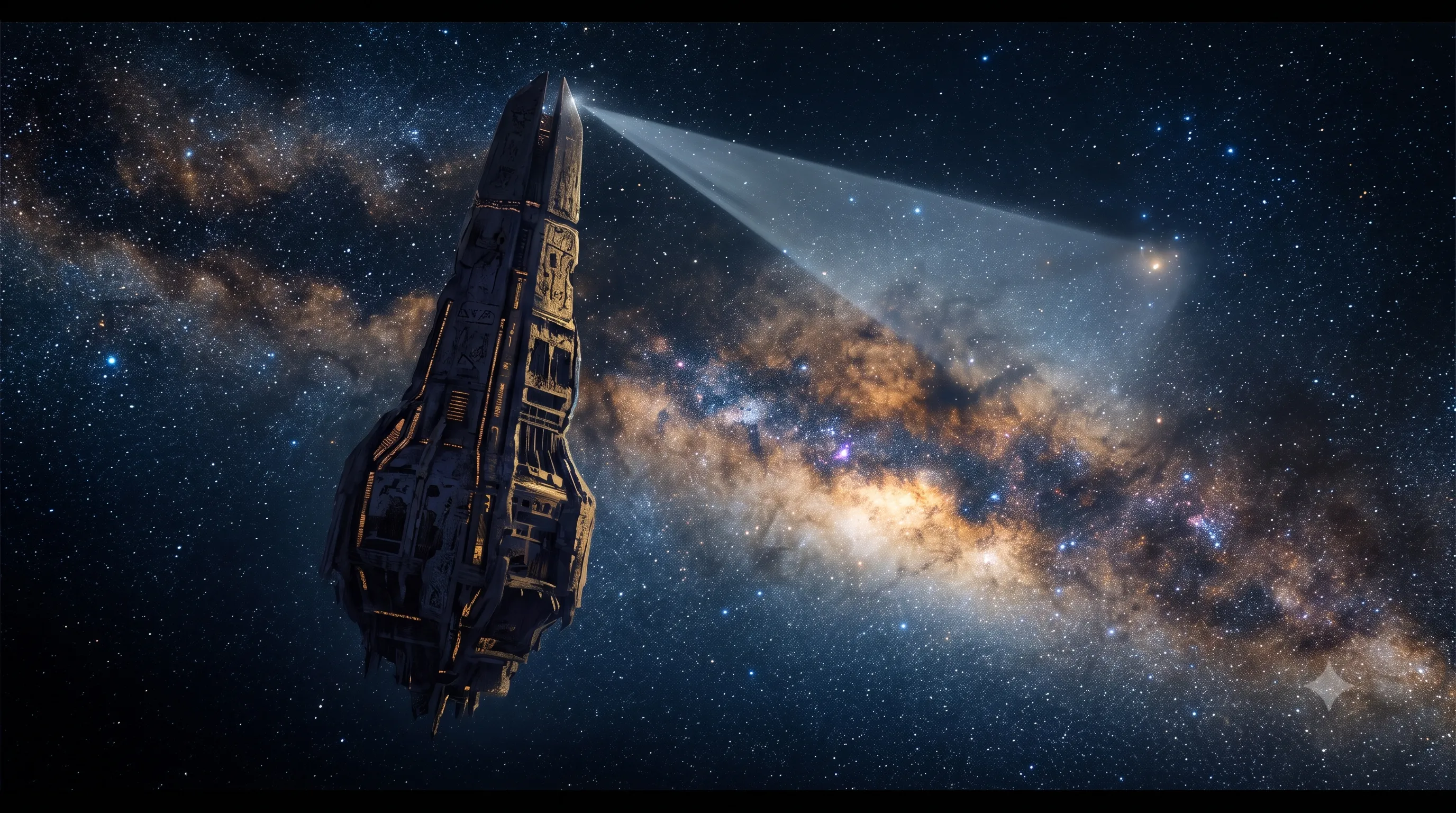
The galactic monument knows nothing about anyone in particular. It buys its way past the demographics with reach instead of knowledge, sweeping the disk from a 4.5-kilometer aperture at roughly 500 GW, and Part 1 priced it at about $30 billion in capital against a 43% chance that somebody is already standing in its footprint on the day it switches on. It is the only sweeping design in the catalog that starts anywhere near even odds, and Part 1’s operating arithmetic forces the rest of its character: a builder paying institutional upkeep is cornered into sweeping for a few decades and stopping, so the design that accumulates recipients is an autonomous artifact, running unattended to the hundred-thousand-year lifetime ceiling and collecting an expected half-dozen recipients across its life. Nor is its schedule uniform, because the broadcaster weights the sweep, dwelling longer and returning sooner wherever its catalog shows a living world.
What the sweep buys a listener the builder knows nothing about is about one second of illumination per year. Whether Earth is such a listener turns out to be a geometry question with a computable answer, taken up below.
The Printout
The Wow! signal was either nature being briefly loud at the one frequency the SETI founders assumed nature kept quiet, or a sweeping beacon that failed its own design review. The far end of the beacon design barbell manufactures Wow!-shaped events. A beam that crosses any given listener for about a second a year is experienced, by nearly everyone it ever touches, as a single bright flash that never comes back. The best beacon money can buy at this range produces, as its ordinary output, detections that cannot be confirmed.
That inverts the problem Part 2 solved. The targeted beacon was continuous, so its candidates could be re-observed on demand, and its builder had selected us, so its search reduced to a finite list; every comfort in that piece came from those two properties, and the monument has neither. There is no list, because the transmitter knows nothing about us and owes us nothing on any schedule. There is no re-observation on demand, because the beam is gone before the discovery software finishes running. What there is instead is a waveform, fixed in surprising detail by the builder’s own cost model; a transient archive that has been recording the sky for decades; and a verification problem whose evidence arrives once, all at once.
The argument runs in that order: what the monument emits, where in our sky a beam that favors us can come from, whether the record could already contain one, what a single pass can prove, and what the 1977 printout — the one candidate in the field’s history that looks anything like this class — can and cannot be made to say.
What the Monument Actually Emits
Everything at this end of the search depends on the waveform, because the waveform is the only thing that distinguishes a monument from the astrophysics it is buried in.
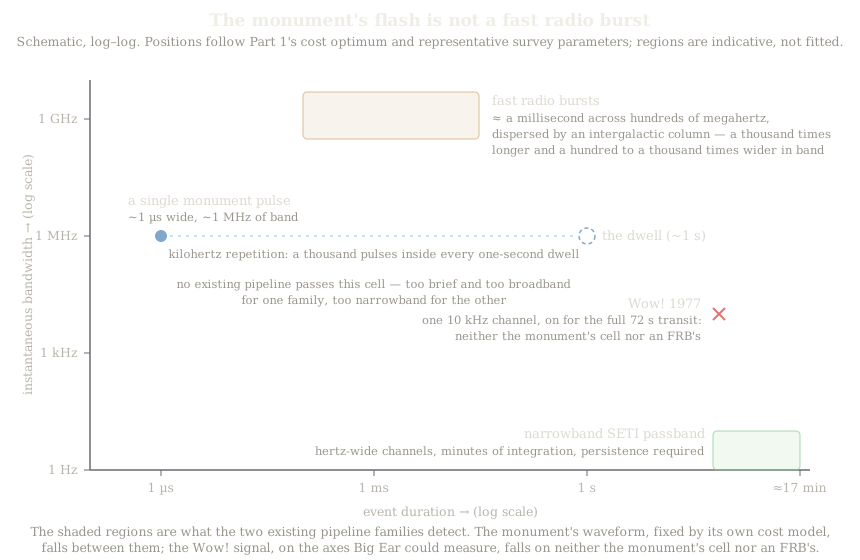
Part 1’s cost model fixes it without any freedom left over. A cost-optimized monument emits microsecond pulses at kilohertz repetition inside a dwell of about a second, in a band roughly a megahertz wide, carrying at most a galactic dispersion measure. It is routinely described as fast-radio-burst-like and it is nothing of the kind: an FRB is a millisecond event spanning hundreds of megahertz to gigahertz, dispersed by an intergalactic column. The monument’s flash is a thousand times shorter, a thousand times narrower in band, and repeats a thousand times inside its own dwell.
That last property is the one that matters, and it is free — which is why the standing assumption that a range-maximizing beacon must be a featureless carrier authenticating only by timing does not survive contact with its own cost model.12 Part 1’s broadcaster writes on it: small pulse-position displacements around the regular grid carry a self-describing header — proof of artificiality, the revisit schedule, an invitation to return with more collecting area — at no cost in link margin, and beneath the header a denser payload legible to any listener who brings a large dish to a scheduled revisit. Since the header costs nothing and the surviving builder’s definition of success is a message received rather than a flash logged, the receiving side’s default hypothesis should be that the flash is a header, not a bare comb.
The waveform is one fingerprint. The sweep is the other. A monument revisits each patch of sky on a fixed cadence, so its flash recurs at the same celestial position at something close to a fixed period: a transient with a year-scale period, a second-scale on-time, and no dependence on anything local to the listener. Under the weighted sweep the cadence is fixed per patch rather than across the sky — cued patches run shorter periods and longer dwells — which changes nothing in the signature except the numbers: recurrence at a fixed position remains the fingerprint, and for a favored listener the period worth searching is months rather than years. And if the builder schedules its sweep against a derivable convention of the SETI Ellipsoid kind, the recurrence epochs are not merely periodic but computable, which converts a candidate from a thing that happened once into a prediction with a date on it.3 A message-bearing monument does the convention one better and announces its own cadence, encoding the next revisit epoch in the dwell itself, so the date is read from the signal rather than derived from a guess about shared reasoning; what that is worth is taken up on the ladder below.
From the receiving side, then, the search cell is specific: microsecond structure, possible ordered displacements at the ten-microsecond scale around a kilohertz grid, a band about a megahertz wide, a dispersion measure no larger than the galactic column toward the source, a dwell envelope about a second long, and recurrence at a fixed position on a cadence of months to years, depending on whether the listener’s patch is in the builder’s catalog. Each of those numbers is set by a different part of the builder’s optimization, and each falls outside what some existing pipeline preserves.
Are We in the Catalog?
Part 1’s broadcaster does not sweep uniformly, and Part 2 ended on the consequence: the sweep dwells longer and returns sooner wherever the builder’s catalog shows a living world, and Earth’s atmosphere has been advertising oxygen for over two billion years. Whether the weighting favors us reduces to one question — can a builder at galactic range know Earth is alive? — and the question has more structure than it appears to.
Run the channels. Our leakage dies within tens of light-years against any receiver anyone has modeled. Direct imaging of an Earth-sized planet at kiloparsecs is beyond every published instrument concept by orders of magnitude. What remains is the channel that does not so much degrade with distance as switch off outside a boundary: the transit. A star in the Earth Transit Zone sees Earth cross the Sun once a year — an 84-parts-per-million dip on a clean period, the atmosphere backlit at every crossing — and the zone is pure geometry, a band of ±0.264° in ecliptic latitude that continues across the entire disk; Part 2’s catalog stops at 100 parsecs because Gaia’s completeness does, not because the zone does. Photometry at that precision on a star that faint, through the plane’s own dust, is a serious instrument assumption and should be named as one. But it is the only channel with a physical path at all, and that yields a strong conclusion: a swept beam that favors Earth can only come from inside the band. From everywhere else in the galaxy, we are a blank patch owed the uniform second.
The band is a great circle on our sky and the builders live in the galactic plane, so the geography of the far-end search reduces to where the two cross. The planes meet at about sixty degrees, and the crossings fall almost exactly on the solstice points of our sky — a coincidence with no significance and some navigational convenience. One node sits at RA 18ʰ00ᵐ, declination −23.4°, in Sagittarius at galactic longitude six degrees — six degrees from the galactic center; the other at RA 6ʰ00ᵐ, declination +23.4°, on the Taurus–Gemini border near the anticenter. The band’s footprint on the plane at each node is a patch of order a square degree. Those patches are where a transmitter can simultaneously sit in the deep stellar disk and watch Earth transit, and the Sagittarius node is the jackpot cell of the entire far-end search: the longest column of stars available anywhere in our sky, every one of them holding the vantage from which Earth’s biosphere has been legible for two billion years. One honest smear applies at range: Earth’s orbital plane nods by a degree or so over the tens of millennia the most distant builders’ light spends in transit, so the node patches blur toward a few times their instantaneous size. The prior has soft edges, not a pencil beam.
What catalog membership buys us, if anyone’s photometry reaches that far, is the two numbers the uniform sweep sets at their worst. Longer dwell is more pulses: more header repeats, more margin, more of the message per crossing. Faster revisit is a shorter recurrence period, which improves the live stakeout and the archival search by the same factor — a beam that returns in months instead of years is a transient an archive can catch twice, and twice is the difference between a curiosity and a coordinate with an appointment attached.
The caveat cuts one way. If no builder’s transit photometry reaches kiloparsecs, the band is nothing special and the sky reverts to the uniform second; the search below loses a priority ordering and nothing else. If anyone’s does, the ordering is forced. Two patches of pointing priority is as cheap as a prior ever costs.
Could the Record Already Contain One?
The question is not hypothetical courtesy. The first fast radio burst was recorded by the Parkes multibeam receiver in 2001 and discovered in 2007, when Lorimer and colleagues reprocessed the archive looking for approximately the right shape; the event that founded a subfield sat on disk for six years because nobody’s software was asking.4 Part 1’s economics sharpens the stakes twice. Even its flagship — the autonomous monument, engineered to outlast its builders — runs for a hundred thousand years against the ten billion the disk has been forming civilizations, so nearly every monument ever built is already dark, and its sweep either crossed Earth while something here was recording or never will. And the operating arithmetic adds a shorter-lived class alongside it: a builder that never engineered its upkeep below the autonomy threshold is cornered into sweeping at full reach for a few decades and stopping, which puts thirty-year windows in the possibility space next to the hundred-thousand-year ones. If any such window has already closed over Earth, whatever was recorded while it was open is all there will ever be.
Two pipeline families patrol the transient radio sky, and the monument’s cell falls in the gap between them. Narrowband SETI pipelines integrate for minutes in hertz-wide channels and demand that a candidate persist across the integration; a flash a second long and a megahertz wide is spread across a million of those channels, contributes almost nothing to any of them, and fails the persistence cut even where it registers. Fast-radio-burst pipelines have the opposite blindness. Their detection statistic sums over hundreds of megahertz, so a signal confined to one megahertz forfeits most of its significance before the threshold is applied — and impulsive, band-limited power is the classic signature of terrestrial interference, which is why every FRB search runs excision stages built to remove it. A monument flash bright enough to trigger either pipeline would most plausibly be recorded by the first as noise and by the second as RFI.
What the archives retain compounds the problem. Survey intensity data is channelized and downsampled before it is written — tens of microseconds to a millisecond in time and tens of kilohertz in frequency are representative of the major FRB backends5 — which preserves the second-long dwell envelope and destroys the microsecond pulse train inside it. In such data the train appears, if it appears at all, as a steady elevation across the dwell, three orders of magnitude below its own peak. Raw voltage, the only data product from which microstructure can be recovered, is kept in ring buffers and written out when a real-time pipeline triggers — CHIME’s public voltage-level releases, for instance, cover 140 bursts of the several thousand in its catalogs.6 The circle closes: the evidence that could authenticate a monument is retained only for events the existing filters already believed, and the existing filters are built to disbelieve this one.
Sky coverage points the same direction. The monument’s beam lives in the galactic plane, since that is where the stars are and a disk-sweeping transmitter has no reason to spend dwell on the poles. The plane is where fast-radio-burst surveys are weakest, avoided where possible and degraded by scattering where not. Wide-field SETI campaigns have demonstrated the searched-volume arithmetic — Tremblay and Tingay’s MWA survey of the Vela region covered ten million stars in a single campaign7 — but in kilohertz channels against persistent narrowband carriers, a morphology the monument does not emit. The instrument whose data most plausibly already holds a monument’s beam crossing is CHIME, which transits the whole northern sky daily and has done so for years; it is also, by construction, running the FRB pipeline described above. The catalog geometry sharpens this into a specific irony: of the two node patches where a beam that favors Earth must originate, the anticenter patch at declination +23° crosses CHIME’s field every day, while the Sagittarius patch at −23° — the one staring down the longest column of stars in the galaxy — sits below its southern field edge and is nobody’s daily field at all.
Astronomy has since demonstrated this failure mode on a natural population. The long-period radio transients — sources that switch on for seconds to minutes at fixed galactic-plane positions and repeat with periods of tens of minutes to hours — entered the catalog through exactly the door this section describes: the first, GLEAM-X J162759, surfaced in a reanalysis of archived MWA data,8 and the second, GPM J1839−10, once found, turned out to have been repeating in radio archives since at least 1988 — thirty-five years of recorded activity that no pipeline had flagged.9 The class is not the monument: the periods are minutes rather than months, the emission is broadband, and the leading explanations are white-dwarf binaries and ultra-long-period magnetars.10 What it proves is the premise: the sky produces recurring, second-to-minute transients at fixed plane positions, and they can sit in recorded data for decades. It also supplies the node prior with its first cheap test. Of the sixteen long-period transients published to date, none sits inside the Earth Transit Zone band, the closest missing by about two degrees — and with a band covering half a percent of the sky, sixteen sources predict fewer than a tenth of a chance hit, so the null constrains nothing yet. But the check exists now, costs an afternoon per discovery, and earns its keep the day the catalog is ten times larger.
Beneath both pipelines sits a population astronomy does not curate: the orphaned candidates. Every transient survey generates single-beam, single-pass events that fail a repetition or broadband criterion and are filed as interference, and almost none are published, because an unrepeated candidate indistinguishable from RFI is career risk with no payoff. The perytons ran that logic to its embarrassing conclusion — years of dispersed-looking transients at Parkes, eventually traced to a microwave oven11 — and the lesson usually drawn is that the filters are right. They mostly are. But a filter tuned until nothing embarrassing survives is also a filter from which no monument can emerge, and the discard pile is not archived at a fidelity that would let anyone check.
So the answer comes in two parts. Could the record contain the detection — a bright, second-long, band-limited transient at a fixed galactic-plane position, perhaps recurring at the same position years apart? Plausibly, in the intensity archives of CHIME and its predecessors, misfiled as interference if it is there at all. Could the record contain the proof, the microsecond pulse train that separates a monument from a magnetar? No. On the authentication axes, archival coverage of the monument’s parameter space is zero rather than small, because the data product that could carry the evidence was never retained. Reanalysis can therefore produce candidates and predicted revisit epochs; it cannot produce a confirmation. The costed program below is built around that division of labor.
Climbing the Ladder in One Pass
Claims of artificiality get discussed as though there were a single threshold to cross. There are at least five, and they are established by different kinds of evidence.
- The event is instrumental reality, not a processing artifact.
- The event is celestial, not local interference.
- The source is artificial.
- The source is extraterrestrial.
- The source was intended as a message or a monument.
Part 2’s targeted beacon can climb this at leisure, because it is still transmitting; a candidate can be re-observed tomorrow by a different observatory with different hardware. The monument affords no such thing. A one-second dwell with an annual revisit has to carry its own proof, in one pass, or wait a year for a second chance that the listener may not be pointed to collect.
Simultaneous detection at widely separated sites, with consistent properties, establishes the first two rungs and can do it in a single shot without any repetition at all. That is how astronomy came to believe in non-repeating fast radio bursts. Sky localization rejects further classes of interference. None of this evidence touches the third rung.
Artificiality is reached by likelihood, not by proof, and each feature a transmitter can carry rejects a specific alternative under a specific background model:
- Anomalous dispersion. Signals crossing interstellar plasma arrive later at lower frequencies, in strict proportion to the inverse square of frequency. A pulse chirped backwards rejects ordinary cold-plasma propagation of an unstructured pulse. It does not reject every natural mechanism, because natural sources can carry intrinsic time-frequency drift, and the strength of the inference depends on how much intrinsic drift the assumed source population is allowed.
- Arithmetically structured sub-pulses or frequency combs. These raise the artificial-source likelihood against a background model of stochastic emission. How much depends on how the background model is specified, and specifying it is where the work is. This is the channel the monument’s own waveform hands the listener for free.
- Predictable timing. Arrival inside a pre-computed window carries evidence proportional to how narrow the window is. If a convention selects one year out of a century of plausible arrival times, a hit inside it is worth about a factor of a hundred in likelihood against timing-indifferent interference. The gain survives only if the convention is pre-registered and, better, derivable, such as “the most recent core-collapse supernova visible to both parties.”312 With hundreds of candidate nova and supernova ellipsoids available, post-hoc timing coincidences are cheap and prove nothing.
The fourth rung is cheap for this class. A source in the galactic plane with a dispersion measure matching the column toward it, no parallax, and no counterpart in the satellite and debris catalogs is comfortably beyond human hardware, and the multi-site coincidence that establishes the first two rungs establishes this one in passing. The fifth rung is different in kind: intent cannot be measured, only made likely, and for a monument the argument is the design review itself — a waveform sitting at a cost optimum nature has no reason to visit, recurring on a computable schedule. The fifth rung is climbed, if it is climbed at all, by economics — with one exception, taken up below, that makes it climbable by experiment.
Timing is the channel the literature leans on hardest for this class, and it is the one that assumes the most. Part 1’s authentication hierarchy ranked arrival timing third of five — above frequency choice, below internal structure — because it requires shared game theory: both parties must reason about coordination the same way, select the same conspicuous event, and derive the same schedule from it. That is a cognitive assumption of the same kind as the founders’ hydrogen-line bet, and the hydrogen-line bet has been wrong for sixty-five years and counting. Internal structure assumes only physics, and the monument’s cost model puts kilohertz repetition inside every dwell for free, so structure is not a luxury the search may hope for but a property of the quarry. Design the search around structure, and treat a pre-registered timing hit as what it is: a factor of a hundred in likelihood where the convention happens to be shared, and nothing where it is not.
The exception to the fifth rung’s unmeasurability is the calendar. Part 1’s message-bearing monument encodes its next revisit epoch in the dwell, in the signal’s own units — displacements counted in its own pulse periods — so a listener who captures a single dwell at voltage resolution can extract a date and book the observation. A prediction extracted in advance and then kept is intent made falsifiable, because no natural source announces its own recurrence; this is the one form of rung five that an experiment can settle. The guardrail is the timing-convention discipline made stricter: the decoding grammar must be registered before any candidate is analyzed, since with enough post-hoc freedom any pulse train can be made to say something. And a kept appointment pays twice, because under Part 1’s layered architecture the scheduled dwell is also the delivery. The flash’s peak flux is sized for threshold detection by wide-field monitors; a listener who returns with a large dish brings orders of magnitude of margin to the identical waveform, and margin is capacity — a megabit-class payload per dwell against the header’s hundred bits, the library arriving in annual installments through the same beam. Confirmation and content run on the same calendar, and the confirmation problem this piece opened with turns out to be one the transmitter’s designer and the search’s designer are solving from opposite ends: the pipeline’s job is to be able to receive the solution.
The Wow! Signal as the Test Case
The Wow! signal now has a serious natural candidate. A team re-observing with Arecibo identified faint narrowband hydrogen-line emission from small cold interstellar clouds and proposed that a rare transient event — a magnetar flare stimulating maser-like amplification in such a cloud — could have produced the 1977 signal.13 The mechanism has never been observed and its own authors call it speculative. The same team’s 2025 archival reanalysis sharpened the signal’s measured position and frequency and raised its peak brightness, supporting an astrophysical origin over interference while explicitly leaving the case open.14
In the hardest cases the contest is unobserved astrophysics against unobserved technology, and the episode underlines that nature may occasionally be loud in precisely the narrowband hydrogen-line form the 1959 framework assumed was reserved for civilizations.
Now run the design review Part 1 promised, with the monument’s waveform in hand. Big Ear’s survey backend recorded fifty channels of 10 kHz each, half a megahertz of band in all, and wrote one intensity per channel every twelve seconds; the printout’s famous six characters are seventy-two seconds of a source drifting through the beam.15 Hold that instrument against the search cell above, axis by axis.
On bandwidth, the one axis Big Ear could measure well, the signal does not match the monument. A cost-optimized flash a megahertz wide would have lit most of the receiver’s fifty channels at once — and would, for that reason, have read as interference. The Wow! signal occupied one 10 kHz channel. If it was a beacon, it was a narrowband sweeper, and under Part 1’s economics a narrowband sweeper is a transmitter from the dominated middle of the catalog, paying the synchronization cost of sweeping and the frequency-guessing cost of narrowband at the same time and buying the demographic wall with the money.
On duration, the envelope is the antenna pattern. The signal rose and fell exactly as a fixed celestial source drifting through the stationary beam should, which means the source was on for at least the full seventy-two-second transit and Big Ear learned nothing about when it started or stopped. That excludes both of Part 1’s sweeping dwells: a one-second galactic-monument flash would occupy a single twelve-second bin, and the mid-range design’s 35-second dwell would have truncated the envelope and did not. Whatever was transmitting behaved, across the only interval anyone was watching, like a continuous source — which is what the classic implicit beacon would look like, and also what a drifting natural emitter would.
On time structure, the axis where a monument’s proof lives, the archive is blind by seven orders of magnitude: authentication sits at microseconds and the record is total power in twelve-second bins. Whether the signal carried sub-second structure is not unknown the way an unmeasured quantity is unknown. The information was integrated away at the receiver and does not exist anywhere.
Geometry adds the one verdict the 1977 archive can still deliver, because position is a quantity Big Ear did record. Both candidate positions — one per feed horn — sit at ecliptic latitude near −5°, more than four degrees outside the Earth Transit Zone band. Whatever transmitted the Wow! signal, if anything transmitted it, has never seen Earth cross the Sun and cannot have held us in a transit-cued catalog. If it was a sweeper, it was sweeping blind: our patch earned the uniform dwell on the uniform cadence, which makes the follow-up arithmetic below as unforgiving as it can possibly be, and removes the one scenario — a favored listener on a fast revisit — under which the decades of stakeout might have had honest odds.
The follow-up record adds less than it appears to. Decades of re-observation of that position — Big Ear’s own hundred-odd rescans, the Very Large Array twice in the mid-nineties, single-dish stakeouts since — amount to at most a few hundred hours, and against a sweeper revisiting for one second a year, even a hundred hours of accumulated stakeout carries an expected catch near one percent. That arithmetic is mine, and it cuts in both directions: the silence since 1977 is fully consistent with a revisiting transmitter and fully consistent with nothing, so it distinguishes the two hypotheses not at all. The message hypothesis makes the archive’s blindness cost twice over, because the integrated-away microstructure is also where a message-bearing sweeper keeps its calendar: if the signal announced its next pass, the date was printed in the first seventy-two seconds and destroyed at the receiver, and the decades of stakeout since have been a search for a recurrence whose appointment card nobody could read.
So the test case returns a negative result, and the negative is structural. On the axes Big Ear could resolve, the Wow! signal matches either the Méndez clouds or a beacon design nobody has a reason to build. On the axis that could have separated nature from technology, the 1977 archive contains no information and can never be made to contain any. The field’s most famous candidate is permanently unadjudicable, because the instrument spent its resolution where the 1959 framework said the signal would be, and the signal — if it was ever a signal — kept its proof where nobody was recording. The verdict is not on the printout. It is on the pipeline, and pipelines are the one thing the field can still change.
A Costed Program for the Far End
1. Run the microstructure audit on the archived transient catalog. Software against data already on disk, so the cost is compute and analyst time, not telescope hours. Every recorded one-off transient — the Wow! archival records, the non-repeating fast radio bursts, the orphaned candidates of past surveys — re-examined not for which astrophysical model fits best but for features plasma physics does not produce: inverted dispersion relations, arithmetically structured sub-pulse intervals, impossible frequency combs. The waveform analysis above gives this search a discriminant it would otherwise lack, since the monument differs from an FRB by three orders of magnitude in duration, three in bandwidth, and everything in internal repetition rate. In parallel, every archived event should be checked against pre-registered, derivable timing conventions for the historical supernova and nova catalog, with the conventions fixed before the check. Any candidate with surviving voltage data — there will be few — should be run through a pre-registered decoding grammar for schedule extraction, and every candidate checked for position coincidence with cataloged nearby stars, a hit marking it as Part 2’s quarry, a targeted transmitter, rather than a monument. Position earns a second sort key from the catalog geometry above: candidates inside the Earth Transit Zone band outrank candidates outside it, and candidates in the two node patches outrank everything, because a cued beam revisits fast enough for a recurrence search across an archive’s span to have real odds. Because this channel presupposes nothing about alien cognition, it is the most assumption-robust search available at any price. Its deliverable, per the archive audit above, is candidates and predicted revisit epochs, not confirmations; the confirmations belong to the next item.
2. Build the persistent galactic-plane stare. The one hardware item in the entire series. A dedicated wide-field transient monitor pointed at the galactic plane, where a sweeping monument’s beam must pass, recording voltage-level data in a rolling buffer so that any transient can receive full retrospective analysis. The pointing priority is set by the catalog geometry: the two square-degree node patches first — and the Sagittarius node needs southern hardware, because the one all-sky transient machine in operation cannot see it — then the rest of the plane. The buffer’s specification is set by the quarry rather than by convenience: time resolution sufficient to read ten-microsecond displacements around a kilohertz grid, because the instrument must be able to read the header, not merely see the flash. The deliverable upgrades with the spec. A tripwire that decodes converts the annual stakeout into an appointment — capture voltage, extract the epoch, book every large dish available for the predicted second — and the appointment into a subscription, since the scheduled dwell is where the dense layer of the message arrives. Its optical counterpart is already being built by others,16 and the division of labor is right, because the monument class is a radio class and the galactic-plane radio stare is the piece nobody owns.
3. De-prioritize programs optimized only for the dominated middle. No new money for searches whose implicit quarry is the moderate-power, moderate-range, untargeted persistent transmitter, which fails on demographics under Part 1’s fiducials. The qualification matters: that result depends on uncertain formation rates and listening lifetimes and is not a proof of formal domination. Existing low-cost commensal coverage of the middle should be preserved, because it is the assumption-light residue that survives if the fiducials are wrong.
Pipelines for this end of the barbell should be designed verification-first, on the assumption that the detection that matters will never repeat: voltage retention around every candidate, real-time cross-checking between independent sites as the substitute for temporal repetition, and timing conventions registered in advance. Results should be reported as posterior constraints in the manner of Grimaldi’s signal-coverage framework,17 with parameter uncertainty propagated per Sandberg, Drexler and Ord.18
Suggested Projects
The costed program above is mostly institutional. A useful fraction of it is not, and decomposes into archival projects a single researcher could run now — each a concrete slice of the microstructure audit, each against data already public.
Keep the ecliptic audit running. The long-period-transient cross-check above is the cheapest standing search in this piece: every new fixed-position recurring transient gets its ecliptic latitude computed on publication, with membership in the band — and above all in the two node patches — as a pre-registered sort key. Sixteen sources in, the band count is zero; the test costs minutes per discovery, and it is exactly the kind of convention that must be registered before a hit rather than derived after one.
Reprocess the Parkes multibeam archive at the Sagittarius node. The Parkes Multibeam Pulsar Survey covered the inner galactic plane — the Sagittarius node deep inside its strip — at 250-microsecond sampling, and its roughly four terabytes are fully public through CSIRO’s data archive. Its single-pulse reanalyses searched for dispersed broadband pulses;19 nobody has searched it for the monument’s morphology, a second-scale envelope confined to one or two of its 3 MHz channels, which is precisely the shape every existing cut discards as interference. The one-bit digitization and coarse channels cap what the data can prove — the microsecond structure is unrecoverable — but a list of band-limited plane transients at fixed positions, cross-matched for recurrence across the survey’s repeated passes, is in the data and has never been extracted.
Image the node patches in the MWA archive. The MWA has archived its visibilities since 2013, public after an eighteen-month embargo, at integration times of half a second to two seconds — the monument’s dwell envelope, natively. Image-plane transient searching at these timescales on this instrument is demonstrated technology,20 and the Sagittarius node rides near the zenith of the array’s best-covered sky, which answers the southern-hardware complaint above at archival prices: the one all-sky machine that cannot see the jackpot cell is not the only archive that can. A differencing search of the node patch across every archived epoch is a defined, finishable project; the anticenter twin is weaker, sitting at the northern edge of the array’s coverage.
Cut the CHIME catalog by the monument’s parameters. The second CHIME/FRB catalog is public: some 4,500 bursts across five years, with per-event emission bandwidths and positions.21 A filter for band-limited events at galactic dispersion measures near the plane, plus a positional-recurrence pass across the catalog’s span, costs an afternoon. The caveat is the one argued above — the pipeline pays an order-of-magnitude penalty on megahertz-wide signals and discards them preferentially as interference, so an empty result constrains little. The reason to run the cut anyway is the events that survived the filters by accident.
Blink the plates. The Harvard plate collection — some 470,000 plates spanning the 1880s to 1992, scanning now complete — is public and queryable by position.22 A century-baseline search of the two node patches for repeated transients at fixed positions is days of work with the archive’s own tools. It tests an optical class the radio argument does not predict, dust toward the Sagittarius node suppresses it, and single-plate events are treacherous; it earns its place on cost alone.
One archive this list conspicuously omits is Big Ear’s. The survey’s two decades of drift scans are public and their geometry — daily transits at fixed declinations — is exactly right for a fixed-position repeat search, but the 1977–1984 records exist as photographed printout pages by the tens of thousands, and the group that digitized the Wow! era is already mining the vein. Transcription at scale is the entry fee, and whoever pays it inherits the whole survey rather than one famous scan.
Concluding Remarks
The two ends of the barbell produce two searches with nothing in common but their parent. Part 2’s search is a list: finite, cheap, finishable, its null carrying an address and a stated sensitivity. This search has no list and cannot finish, because silence toward any particular listener is a property of the monument’s design, and no quantity of quiet years counts against a transmitter that illuminates you for a second per year. The near end’s search is complete when the last system on the list has been observed. The far end’s search is complete only in the sense that a tripwire is complete: built, calibrated, and waiting.
What the far end offers in exchange is the larger prize. A targeted beacon found at a nearby M dwarf is a conversation, decades round trip. A monument found in the plane is an artifact almost certainly older than its builders, erected by one of the rare actors with near-zero time preference, and its existence would establish that the galaxy has at least once produced an institution that thought in hundred-thousand-year commitments. Under the message economics it is probably not mute, since the header costs its builder nothing and the dense layer rides dwells a large dish can read, so a monument with nothing to say is the design that needs explaining; the prize is not only the artifact but the library it delivers, megabits a year, to whoever keeps the appointment. The detection, if it comes, arrives cheap — the program above is software, one instrument, and patience, priced in millions against the transmitter’s tens of billions. At both ends of the barbell the listener gets the better side of the trade, and at this end it is not close.
Both searches inherit the same lesson from Part 1. The beacon the field spent sixty-five years equipped to find — moderate power, narrowband, continuous, aimed at nobody — is the design no stated objective funds, and the two designs the economics does fund were both invisible to the historical search: one because its targets are dim red stars a 1990s astrometric catalog never recorded, the other because its flash is deleted as interference by every pipeline that might have caught it. The failure was never diligence. The field searched carefully for the transmitter that made sense to the searcher, when the transmitter that makes sense to a builder was the thing to price first.
One thread from Part 2 ties off here. That piece found every technosignature Earth emits fading by accident of progress — carriers switched off, pollutants regulated away, the radar fallen down — each one a signature we briefly chose to have. The signature this piece navigates by is the other kind: the atmosphere has been transmitting on our behalf for two billion years, answers to no policy, and is readable along one thin band of sky whose crossings with the galactic plane have coordinates we can point at tonight. Our most persistent broadcast was never ours to schedule.
Which returns, one last time, to the printout. In 1977 the question was: what was that? Priced against the catalog, the question becomes: what would we have needed to be recording to know — and why, forty-nine years later, are we still not recording it? If a monument is sweeping the disk tonight, its beam will cross some telescope’s field for about one second. Everything in this series comes down to what the machinery behind that feed does with the second it gets.
References
Footnotes
-
Benford, J., Benford, G. & Benford, D., “Messaging with Cost-Optimized Interstellar Beacons,” Astrobiology 10(5), 475–490, 2010. https://arxiv.org/abs/0810.3964 ↩
-
Benford, G., Benford, J. & Benford, D., “Searching for Cost-Optimized Interstellar Beacons,” Astrobiology 10(5), 491–498, 2010. https://arxiv.org/abs/0810.3966 ↩
-
Davenport, J. R. A. et al., “Searching the SETI Ellipsoid with Gaia,” Astronomical Journal 164, 117, 2022. https://iopscience.iop.org/article/10.3847/1538-3881/ac82ea ↩ ↩2
-
Lorimer, D. R., Bailes, M., McLaughlin, M. A., Narkevic, D. J. & Crawford, F., “A Bright Millisecond Radio Burst of Extragalactic Origin,” Science 318, 777–780, 2007. https://arxiv.org/abs/0709.4301 ↩
-
CHIME/FRB Collaboration, “The CHIME Fast Radio Burst Project: System Overview,” ApJ 863, 48, 2018. https://arxiv.org/abs/1803.11235 ↩
-
CHIME/FRB Collaboration, “Updating the First CHIME/FRB Catalog of Fast Radio Bursts with Baseband Data,” 2023. https://arxiv.org/abs/2311.00111 ↩
-
Tremblay, C. D. & Tingay, S. J., “A SETI Survey of the Vela Region Using the Murchison Widefield Array,” PASA 37, e035, 2020. https://arxiv.org/abs/2009.03267 ↩
-
Hurley-Walker, N. et al., “A Radio Transient with Unusually Slow Periodic Emission,” Nature 601, 526–530, 2022. https://www.nature.com/articles/s41586-021-04272-x ↩
-
Hurley-Walker, N. et al., “A Long-Period Radio Transient Active for Three Decades,” Nature 619, 487–490, 2023. https://www.nature.com/articles/s41586-023-06202-5 ↩
-
Rea, N., Hurley-Walker, N. & Caleb, M., “Long Period Transients (LPTs): A Comprehensive Review,” Journal of High Energy Astrophysics, 2026. https://arxiv.org/abs/2601.10393 ↩
-
Petroff, E. et al., “Identifying the Source of Perytons at the Parkes Radio Telescope,” MNRAS 451, 3933–3940, 2015. https://arxiv.org/abs/1504.02165 ↩
-
Cabrales, B. et al., “Searching the SN 1987A SETI Ellipsoid with TESS,” Astronomical Journal 167, 101, 2024. https://arxiv.org/abs/2402.11037 ↩
-
Méndez, A., Ortiz Ceballos, K. N. & Zuluaga, J. I., “Arecibo Wow! I: An Astrophysical Explanation for the Wow! Signal,” 2024. https://arxiv.org/abs/2408.08513 ↩
-
Méndez, A. et al., “Arecibo Wow! II: Revised Properties of the Wow! Signal from Archival Ohio SETI Data,” 2025. https://arxiv.org/abs/2508.10657 ↩
-
Ehman, J. R., “The Big Ear Wow! Signal: What We Know and Don’t Know About It After 20 Years,” 1997; see also Gray, R., The Elusive Wow, 2012. http://www.bigear.org/wow20th.htm ↩
-
Wright, S. A. et al., “Panoramic Optical and Near-Infrared SETI Instrument: Overall Specifications and Science Program,” Proc. SPIE 10702, 107025I, 2018. https://arxiv.org/abs/1808.05772 ↩
-
Grimaldi, C., “Signal Coverage Approach to the Detection Probability of Hypothetical Extraterrestrial Emitters in the Milky Way,” Scientific Reports 7, 46273, 2017. https://www.nature.com/articles/srep46273 ↩
-
Sandberg, A., Drexler, E. & Ord, T., “Dissolving the Fermi Paradox,” arXiv preprint, 2018. https://arxiv.org/abs/1806.02404 ↩
-
Mickaliger, M. B., McEwen, A. E., McLaughlin, M. A. & Lorimer, D. R., “A Study of Single Pulses in the Parkes Multibeam Pulsar Survey,” MNRAS, 2018. https://arxiv.org/abs/1807.00143 ↩
-
Kemp, I., Tingay, S., Midgley, S. & Mitchell, D., “An Image-Based Blind Search for Fast Radio Bursts in 88 Hours of Data from the EoR0 Field, with the Murchison Widefield Array,” Astronomical Journal, 2024. https://arxiv.org/abs/2408.12200 ↩
-
CHIME/FRB Collaboration, “The Second CHIME/FRB Catalog of Fast Radio Bursts,” 2026. https://arxiv.org/abs/2601.09399 ↩
-
Williams, P. K. G., “DASCH: Bringing 100+ Years of Photographic Data into the 21st Century and Beyond,” Proc. ADASS 2024, 2025. https://arxiv.org/abs/2501.12977 ↩
This article represents my personal opinions and research. Nothing in this article should be taken as professional, financial, legal, or investment advice.