Rethinking SETI Part 1: The Beacons Worth Building
For sixty-five years the search for extraterrestrial intelligence has listened for one kind of signal: a narrowband radio carrier, transmitted persistently, at a frequency we might guess, from a civilization that wants to be found. The founders asked what such a signal would look like and what it would take to hear it. Almost nobody asked the question that governs the other end of the line: who pays for that transmitter, and what do they get for the money? This piece prices the beacons. Strip the motives down and there are only two reasons to build one — to be heard, or to be answered — and the answer has an uncomfortable shape: the designs either motive would actually fund sit at the extremes of the catalog, galaxy-scale broadcasts built to outlive their builders at one end and quiet transmissions aimed at confirmed neighbors at the other, while the beacon we spent six decades searching for sits in the middle, where neither motive reaches.
A Design Review for the Wow! Signal
On 15 August 1977, Ohio State University’s Big Ear radio telescope recorded a narrowband signal near the hydrogen line that rose and fell over 72 seconds, the time a fixed celestial source takes to drift through the telescope’s stationary beam. The astronomer Jerry Ehman circled the intensity sequence on the printout and wrote “Wow!” in the margin.1 The signal has never repeated, and decades of follow-up at that position found nothing.
The Wow! signal is usually presented as a mystery. It works better as a design review. Suppose it was a beacon. Was it a well-designed one? Big Ear recorded no structure that could have established artificiality: a single 50 kHz channel, one instrument, one pass, no repetition. Whether the transmitted signal carried authenticating structure the receiver could not resolve is a separate question, and nothing in the archive can settle it. A signal whose proof of artificiality lives below its intended receiver’s resolution has purchased ambiguity at full price.
The generalization is what the rest of this piece is about. Most SETI discussion asks what we should build to listen; ask instead what a builder would construct to transmit, what it would cost, and what the return could plausibly be, and much of the historical search space turns out to be optimized for transmitters that no stated builder objective would fund.
How SETI Decided What Aliens Sound Like
Interplanetary signaling spent the late nineteenth and early twentieth centuries as a semi-respectable enthusiasm aimed mostly at Mars — Tesla’s claimed receptions at Colorado Springs, a partial “National Radio Silence Day” during the close opposition of 1924 — and left behind not momentum but stigma.2 The founders of modern SETI worked around that reputation, and the need for respectability shaped their technical choices. The emphasis on narrowband signals was never purely about physics: a signal confined to a few hertz is something no known natural process produces, so a narrowband search yields publishable null results and a narrowband detection cannot be laughed out of the room. A search design optimized against professional embarrassment is not necessarily optimized against the distribution of alien behavior.
In September 1959 the Cornell physicists Giuseppe Cocconi and Philip Morrison published a two-page paper in Nature that created the modern field.3 Their contribution was an engineering argument. Microwave radio occupies a naturally quiet window: at shorter wavelengths atmospheric and thermal noise dominate, at longer wavelengths the galactic background does. Within it they proposed a meeting frequency of 1420 MHz, the 21-centimeter line of neutral hydrogen, on the grounds that two parties who have never communicated can still converge on the same dial setting. Telescopes already in existence, they showed, could detect a deliberately aimed transmission from stars tens of light-years away; and they closed with the sentence that became the field’s charter, that nobody can estimate the odds of success but they are certainly zero if we never look.
Frank Drake had independently reached the same conclusion, and in April 1960 Project Ozma pointed an 85-foot telescope at two nearby sun-like stars, listened near 1420 MHz for roughly 150 hours, found nothing, and demonstrated that a mainstream observatory could run such a search without institutional damage. The Green Bank meeting the following year produced the Drake equation; NASA’s 1971 Project Cyclops study established the technical vocabulary and proposed the “water hole,” the band between the hydrogen and hydroxyl lines.4
The assumption stack
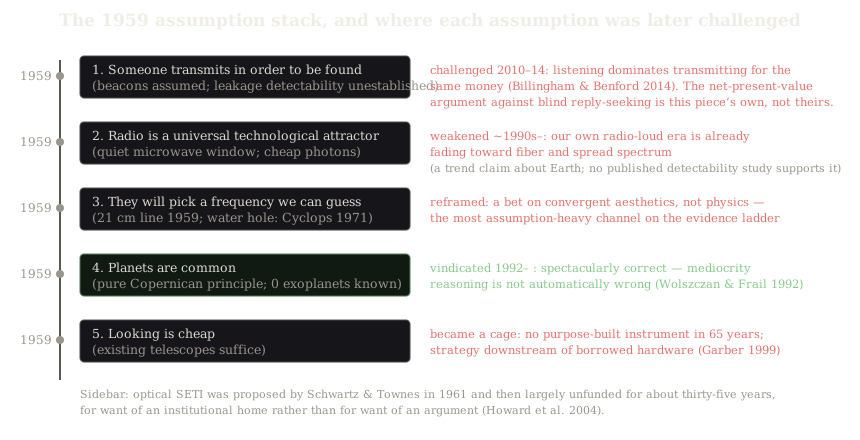
Compressed, the founding framework rests on five assumptions.
- Someone is deliberately transmitting in order to be found. This is load-bearing and usually invisible. Cocconi and Morrison did not propose eavesdropping on alien television; their link budget assumed a beacon, deliberately constructed, deliberately aimed, and paid for. From day one the search was for aliens who had decided to be found — yet nobody asked what deciding to be found would cost, or what the builder gets back.
- Radio is a universal technological attractor. The physics is sound. The inference smuggles in a developmental claim, that any technological species passes through a radio-loud phase and stays in it long enough to matter.
- They will pick a frequency we can guess. The 21-centimeter argument is game theory, a coordination point selected without communication, and it assumes the other mind runs the same reasoning over the same salient facts, which is a claim about cognition.
- Planets are common. Believed in 1959 on the Copernican principle alone, and vindicated spectacularly. It stays on the list because it turned out right: reasoning from mediocrity is not automatically wrong, and the critique below should not curdle into reflexive dismissal of every founding bet.
- Looking is cheap. Cocconi and Morrison’s closing move was that existing telescopes sufficed. This became the field’s permanent pitch and its permanent cage, because a search that argues it needs no purpose-built instrument never builds the political case for one. Sixty-five years later SETI still largely borrows telescopes designed for other purposes, inheriting their frequency coverage, beam widths, and pointing habits.
Instrument availability steered the search harder than any assumption on the list. In 1961 Robert Schwartz and Charles Townes proposed optical SETI in Nature, pointing out that a laser pulse can briefly outshine its parent star in a narrow band.5 Townes had co-invented the maser, so the source was unimpeachable; the proposal was set aside for decades anyway, not refuted but unfunded, because radio astronomy had observatories and communities and habits and optical SETI had none. Townes pressed the case again in 1983, arguing that once photon counting rather than linear detection is admitted and the directivity of short wavelengths is taken seriously, the infrared needs somewhat less power than the microwave region — and was set aside again.6 Modern optical programs date substantially from the late 1990s.7 The strategy followed the hardware inventory.
What a Beacon Can Be
Before asking who would pay for a transmitter, it is worth setting out what there is to buy. A beacon is not one object with a power knob. It is a set of largely independent design choices, and the field’s disagreements are almost all disagreements about which way to turn one of six dials.
How it points. A transmitter can radiate into every direction at once or concentrate the same watts into a narrow cone. The standard bookkeeping is effective radiated power, physical power multiplied by antenna gain, gain being roughly the factor by which the beam is smaller than the whole sky. Gain is cheap range: a 100-meter dish at 21 cm wavelength concentrates by about a million, and a beam costs far less than a millionfold increase in power. What it spends is sky, because a high-gain transmitter illuminates a millionth of the sky at any instant and something has to choose which millionth.
Where it points. That choice splits the design space in two. A sweeping beacon sweeps across the sky, dwelling briefly on each slice of sky, returning after some revisit period, and needs to know nothing about who is out there. A targeted beacon holds still on a single target, which requires that its builder has reason for targeting it. Sweeping drags in a problem that shapes everything downstream: toward any particular listener a sweeper is dark almost all of the time, and whether two parties who have never spoken can be pointed at each other during the same few seconds is the coordination problem the field calls synchronization.
How the signal is structured. A transmitter can radiate continuously or in pulses, and what the receiver experiences is not the pulsing but the repetition rate: a train of microsecond pulses arriving a thousand times a second is for any practical purpose a signal that is always there, whereas a flash that comes once a year is not. The other choice is what rides on the waveform. A bare carrier is the cheapest detectable signal there is and the hardest to prove artificial, its only claim being that no known process makes one, while structure — sub-pulses, chirps, modulation, anomalously narrow lines — costs link margin and buys provability.
Where it sits in the spectrum. Two choices live here and they are routinely conflated. The first is waveband: microwave radio, where the sky is quiet and watts are cheap, against optical, where the same aperture delivers some ten orders of magnitude more gain. The second is bandwidth: a narrowband carrier puts all its flux in one channel, which maximizes what a receiver tuned to that channel sees and minimizes the chance that any receiver is, against a broadband signal that survives the receiver’s ignorance of where to tune and spends flux doing it. The field settled the first question in 1959 and the second by inheritance. Physics settles neither.
How long it runs. Operating lifetime is a design parameter, and it is the one most often left out of beacon proposals. A transmitter that runs for a century is a project; one that runs for ten thousand years is an institution or an artifact; one that runs for a hundred million years has outlived not only its builders but any defensible engineering claim. What distinguishes the buildable tiers is what the builder is waiting for; the last is a boundary the catalog below will need to draw explicitly.
How much it assumes about the receiver. Every beacon leans on some shared premise: a frequency both parties find salient, an event both have witnessed, a convention for when to look, a code. Leaning is free to build and expensive to rely on, since a premise the other party does not share is a transmission into a receiver that will never recognize it.
Several points in that space have been proposed or assumed, and most historical searching assumed one of them without saying so. Two are worth setting out in full: the beacon the field’s search architecture implies, and the only beacon anyone has costed. In both, waveband is held at radio, because the literature holds it there.
The classic implicit beacon
Set the dials the way sixty-five years of search strategy assumes they are set and a specific transmitter appears. Moderate power, enough to close the link and nothing extravagant. Continuous, so that a listener who tunes in at any moment hears it. Narrowband, a carrier a few hertz wide, on the grounds that nothing in nature makes one. Parked at a guessable frequency, the hydrogen line or somewhere in the water hole. Long-lived, running for as long as it takes. And aimed at no one in particular, radiating broadly or drifting across the sky, because the builder is presumed not to know where anybody is.
No paper quite champions this design. It is nonetheless what the standard strategy — long integrations on individual stars, narrow channels, a pipeline that discards anything not persisting across the integration — is optimized to find, and it is the transmitter the field’s own search architecture implies. Its distinguishing feature is how hard it leans on the last dial, since it assumes the listener converges on the same frequency and buys nothing else with what it spends there. Its other distinguishing feature is that nobody ever priced it. Continuous watts are the most expensive kind, a narrowband carrier confines its flux to a channel the receiver has to guess, and the design’s virtue of being always on and always confirmable is purchased at the highest cost per light-year in the catalog. Whether a builder would want it is a question the field never asked, because the design was never proposed. It was inherited.
The cost-optimized beacon
In a pair of 2010 papers, James, Gregory and Dominic Benford asked what a beacon would look like if its builders cared about money.8,9 Theirs remains the only worked cost model in the literature, and its answer contradicts the classic design on nearly every dial.
The model is an exercise in buying effective radiated power at the lowest price. EIRP is power times gain, gain grows as the square of aperture diameter, and the two factors are bought in different markets: watts from transmitters priced per watt, gain from aperture priced per square meter. Any given EIRP can be reached with many watts through a small dish or few watts through a large one, and the cheapest route lies in between, at the point where the marginal dollar buys the same EIRP either way — which turns out to be where capital is split evenly between the two. That optimum then propagates. Required EIRP grows as the square of range, so at the optimum both cost and power scale linearly with range and aperture as its square root: doubling a cost-optimized beacon’s reach doubles its price, which is a far gentler law than the inverse-square intuition suggests.
Three dials then fall out of the arithmetic.
Pulsed, not continuous. Detectability depends on peak flux, and peak watts are much cheaper than average ones — the papers price pulsed power near three cents per watt. So the beacon radiates microsecond pulses at kilohertz repetition, which is a negligible average power and, to a receiver integrating over even a millisecond, a signal that is simply present.
Broadband, not narrow. A narrowband carrier is a bet that the listener is already tuned to the right channel. Spreading the same pulse across roughly a megahertz costs flux per channel and buys survival against the receiver’s ignorance of where to look, and because the pulses can carry structure it also buys room for what the second paper proposes the pulse train should encode: coded pointers toward a higher-content transmission elsewhere.
Sweeping, not fixed. A builder that knows nothing has no address to stare at, so the beam scans, dwelling on each patch of sky and returning after some revisit period. This is where the savings are actually realized, and it is where the design’s central liability lives, because a sweeping transmitter is dark toward any particular listener almost all of the time.
Two worked examples anchor the model. At medium range, the papers’ short-pulse entry reaches 1,080 light-years on W of EIRP: 21.9 GW of optimum power through a 0.91 km aperture, microsecond pulses at kilohertz repetition, a 35-second dwell on each target and a one-year revisit, for $1.3 billion in capital. At long range, the same law carried to 10,800 light-years costs $13.1 billion, with the scaling putting it near 220 GW through a 2.9 km aperture. Watch what happens to the dwell between the two. Aperture grows as the square root of range, so gain grows in proportion to range, the beam narrows by the same factor, and there are ten times as many patches of sky to visit; at a fixed one-year revisit the dwell drops from 35 seconds to a few. Range is bought partly with money and partly with the listener’s odds of looking during the right second, and only the first of those currencies appears on the builder’s balance sheet.
What the papers leave open is the range at which such a beacon actually gets built. It is a free parameter there, not a result, and supplying it is most of what the economics below does.
What a Builder Can Buy in Authentication
A beacon that cannot be recognized as a beacon has failed at being one. A transmitter whose signal is indistinguishable from a magnetar flare has purchased, whatever it spent, a contribution to someone else’s astrophysics catalog. So one more piece of the catalog needs setting out before the question of who pays can be asked: the menu of ways a signal can prove it was built, and what each item demands of the two parties.
The place to start is the bare tone: maximally detectable and minimally provable, discriminated from nature only by the argument that no known mechanism produces it, which leaves it permanently one clever astrophysics paper from dismissal.10 Provability is part of any builder’s product, and it is bought with whatever the design can afford.
The available channels arrange themselves into a hierarchy ordered by how much shared cognition each one requires between transmitter and receiver. This is a menu of what a transmitter can purchase, a different object from the evidentiary question of what a receiver can conclude.
- Internal structure. Inverted dispersion chirps, structured sub-pulses, anomalously narrow linewidths, nanosecond pulse pairs. Requires nothing shared but physics: plasma dispersion is the same for every observer in the universe, and so is the Doppler width of hot gas.
- Response timing. Arrival at twice the light-travel time from the receiver’s own technosignature onset. Requires physics plus a single inference too thin to count as cognition: having detected them, transmit toward them. This is the SETI Ellipsoid with both foci collapsed onto the receiver, degenerating to a sphere of radius .
- Arrival timing. Ellipsoid conventions against a shared external event. Requires shared game theory, that both parties reason about coordination the same way.
- Frequency choice. The hydrogen line, the water hole. Requires shared aesthetics, that both parties find the same facts salient.
- Decoded content. Requires the most, enough shared context to recover meaning.
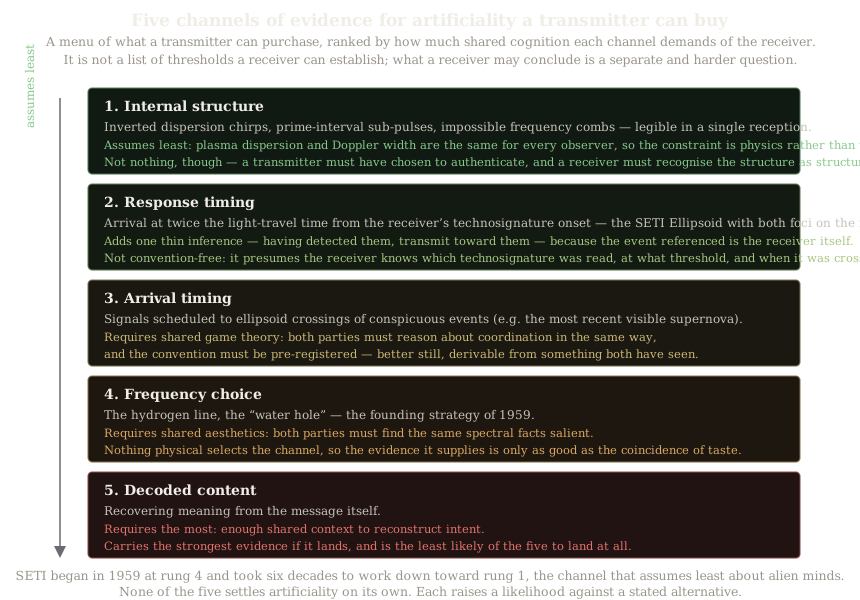
Read the field’s history against this hierarchy and its trajectory becomes visible. SETI began in 1959 at frequency choice, the second most cognition-hungry channel on the menu, betting on shared aesthetics, and took six decades to work down toward internal structure, the only channel that assumes nothing about alien minds. Which channels a given builder buys, though, depends on what it is buying them for — and that is a question about buyers.
The Builder’s Problem
The word “rational” does a great deal of undeclared work in SETI arguments, silently changing objective function between paragraphs. Strip the motives down and there are exactly two reasons to build a transmitter, and they define two buyers who do not shop alike.
The message broadcaster wants its message received. Its figure of merit is the expected number of recipients per unit budget, a recipient being a mind that detects the signal, recognizes it as artificial, and can read whatever was sent. It expects no reply, so it does not discount in any ordinary sense: a recipient ten thousand years from now counts the same as one tomorrow. What the message is remains a free dial inside the class, from a bare verifiable hello — the recipient learns only that someone built this, which is not nothing — to a discovery signal carrying a header and a library behind it.
The reply-seeker wants an answer within a time span that matters to it, institutional or civilizational. It is buying a conversation, and it discounts. Its figure of merit is net present value, and time enters the calculation twice: once as the wait before anyone detects the beacon, and again as the round-trip light lag before a reply can arrive.
Cost-sensitivity is not a third buyer but a constraint on both, and every conclusion below is conditional on one of these two objectives. A design that fails for the reply-seeker can be perfectly sensible for the broadcaster.
What the builder knows
Before either buyer chooses a waveband or a power level, it faces the decision that dominates both figures of merit: what does it know about where its listeners are?
A builder that knows nothing must treat every star as equally likely to be listening and sweep the whole sky, and its only lever against the resulting demographics is range. A builder with spectroscopic capability slightly beyond ours can identify worlds whose atmospheres carry biosignatures, a short list of addresses where life — though not necessarily a listener — is confirmed. And a builder that has watched one of those worlds turn technological holds a confirmed address, where a listener is not hoped for but observed.
Call this the ladder of knowledge. Its three rungs — ignorance, life detected, technology detected — are climbed with astronomy rather than transmitter engineering. But the rungs do not name one beacon class each; they name inputs to design. Ignorance forces the sweep. A biosignature catalog, it will turn out, is worth a re-weighting of the sweep’s schedule and nothing more. A technosignature is worth a dedicated transmitter. The most consistent result below is that what a builder’s money buys is set less by its budget than by what its telescopes have found.
How long a beacon can last
One more assumption has to be laid down before the catalog can be priced, because a design below dies on it. A transmitter that runs for a century is a project; one that runs for ten thousand years is an institution or an artifact; one that runs for a hundred thousand is an artifact engineered with unreasonable success, and all of these can be entertained. What cannot be entertained on any engineering grounds anyone can state is a machine that operates for a hundred million years: no human artifact has functioned for a ten-thousandth of that, and a design whose payoff depends on one is resting its entire case on hardware nobody can describe. Call the boundary the lifetime ceiling and set it generously at years, the value the fiducials in Appendix A already assume for mean beacon lifetime. Any design whose payoff arrives only beyond the ceiling is excluded from the catalog, whoever the buyer and whatever the watts.
The ceiling is the catalog’s most contestable number, and at least one published transmission model simply refuses it. Zuckerman, modeling what a “purposely communicative” civilization would do, assumes builders millions to hundreds of millions of years old — on the argument that if technological life is not exceedingly rare, its typical specimen must be venerable — and equips them accordingly: space interferometers that have surveyed every old solar-type star within 200 parsecs, a catalog of the few hundred living worlds among them, and a continuous, stellar-powered, 60 MW transmitter parked on each, running out the hundred-million-year emergence lag the ceiling is about to rule fatal.11 Nothing in the engineering decides between the two anchors, because neither side has an artifact to point to; the choice is which unmeasured number to reason from, our own engineering record or his selection argument. The catalog below bets on the ceiling, for the reason already given — a payoff that depends on hardware nobody can describe is not a design but a wish — but the bet should be watched doing its work: lift the ceiling and the biosignature-targeted fleet revives on the spot, the middle of the design space acquires the buyer this piece says it lacks, and even the reply-seeker’s ledger changes, since a builder that patient can carry round trips measured in millennia. The one comfort is that the wager is cheap to test from the receiving end. Zuckerman’s design, unlike the ceiling’s survivors, is continuous, high-margin, and pointed at us, which makes it bright enough to appear in sky surveys never built to look for it — the constraint Part 2’s audit collects.
The Message Broadcaster
The broadcaster’s figure of merit — expected recipients per unit budget — admits no discounting, so this buyer can shop the entire catalog up to the lifetime ceiling, including designs whose recipients arrive long after the builder is gone. Its walk through the catalog starts at the bottom of the ladder, with the only purchase available to a builder that knows nothing about its audience.
The sweep against ignorance
The bottom rung of the ladder has been engineered carefully, and the engineering belongs to the Benfords. Their cost-per-detection optimum accepts a very low duty cycle toward any given target in exchange for covering vastly more targets. Take the medium-range worked example set out above as the design under test.8
Two properties of sweeping beacons need establishing before the demographics can be run, because both defy intuition.
Beaming buys less than intuition suggests
A transmitter can concentrate power into a narrow beam, extending its range in the pointed direction. For a sweeping beacon and an episodically observing listener, that largely does not improve the odds of being found.
The argument is bookkeeping. Two quantities set a sweeping beacon’s expected detections: the volume of space within detection range, , which determines how many listeners the beacon can reach, and the duty cycle , the fraction of time the sweep spends illuminating any one of them. Write effective radiated power as physical power times antenna gain . Beyond a few hundred parsecs the detectable volume is a flat slab, the galactic disk, so the volume within range grows in proportion to ; but a narrower beam covers less sky at any instant, so the fraction of time it illuminates any particular listener falls as one over the gain. The expected detection rate is the product of the two, and the gain cancels out of it:
In the disk regime a sweeping beacon’s expected detections depend only on radiated power. A higher-gain design reaches more listeners and illuminates each of them more rarely, in exact proportion; a lower-gain design trades the other way.
The cancellation also carries an assumption about the listener. It holds when the listener observes episodically, sampling stars now and then, so that its observing duty cycle is independent of the transmitter’s gain. A listener running a persistent wide-field monitor catches the beam on every sweep, and for that listener gain regains its full value. The transmitter cannot know which kind of listener it has, but it does not need to, because the bet is asymmetric: against episodic listeners extra gain breaks even in expectation, and against monitors it wins by the whole gain. Beaming is not a wager on the receiver’s architecture but a free option on it — and the favorable branch is not exotic, since wide-field transient monitors are instruments astronomy builds for its own reasons; ours are the very telescopes that catch fast radio bursts.
Transience transfers the cost to the receiver
The cost-optimized beacon saves money by being transient, and transience is not free. A transmitter dwelling briefly on a target at long intervals has a small transmit duty cycle toward it; a receiver with finite dishes and finite hours has a small observing duty cycle toward any given star; and with no shared convention telling either when, the odds the two windows overlap are the product of two small numbers. The medium-range design’s 35-second dwell and annual revisit make a transmit duty cycle of ; if the receiver grants that star a comparable share of its time, blind coincidence runs near . Compensating means buying enormous dwell time and sky coverage, plus institutional patience measured in decades with no interim results, which is harder to fund than either. Their own receiving-side analysis acknowledged this, noting that astronomy’s requirement that a signal repeat before it is believed is also a demand on the listener’s persistence.12 For a builder minimizing its own outlay this is no objection, since the receiver’s costs are not in its objective function; for anyone hoping to be detected within a program’s lifetime, it is the design’s central problem.
The demographic wall
Now run the numbers on the medium-range design. How long must it operate before anyone plausibly notices?
The chain needs four inputs, all derived in Appendix A and all chosen to be generous to the transmitter. Let the galaxy produce new technological civilizations at per year — one every five hundred years somewhere in the disk, the optimistic end of Drake-equation practice. Give each one a listening lifetime of years, a hundred times longer than we have managed so far. Grant that a listener inside the beacon’s range has a coupling probability of actually catching it — sky coverage, frequency coverage, and pipeline assumptions all cooperating — which is kinder by orders of magnitude than the coupling our own search history would earn. And take the geometry as it is: the beacon’s 1,080-light-year sphere encloses about cubic parsecs against a galactic disk of , so the design reaches 0.07% of the galaxy.
The rest is multiplication, worked in Appendix A. The standing population of active listeners at switch-on comes out near 0.0014 — the beacon lights up into a volume almost certain to contain nobody — and it needs roughly five million years of operation, longer than the genus Homo has existed, to reach even odds of a single detection.
No engineering refinement rescues it. Beaming, pulsing, clever scheduling and clever encoding all multiply the probability of being caught per existing listener; none of them creates a listener, and demographics is the one axis no cleverness touches. The moderate-range beacon is what classic SETI implicitly searched for, and it is the design no buyer has reason to construct. The classic implicit beacon fails the same test from a worse price, since a continuous narrowband carrier buys fewer light-years per dollar than a pulsed one.
The scale of the failure is easiest to see by asking how far a sweeping beacon must reach before it is even money that anyone is already listening on the day it switches on. Under the fiducials in Appendix A, the answer is a footprint covering roughly half the galactic disk. Ignorance, for a sweeping beacon, is not a handicap at the margin; it prices every design below galactic scale out of the market.
A methodological warning belongs here, because all of this is built from multiplied guesses. In 2018 Anders Sandberg, Eric Drexler and Toby Ord showed that much of the apparent force of the Fermi paradox is an artifact of arithmetic, since multiplying point estimates of wildly uncertain parameters manufactures false confidence.13 Recast the same Drake-style calculation with probability distributions over each parameter and the result spans more than thirty orders of magnitude. Every number in this piece is a fiducial scenario value, a point estimate chosen to be generous to the transmitter, and not a median of any documented distribution. The figures are for comparing strategies against each other and are close to useless as forecasts. Push civilization formation up two orders of magnitude and the mid-range design becomes viable; push listening lifetimes to millions of years and it becomes viable a different way. What the fiducials establish is that the middle of the design space is fragile in a way the extremes are not, which is a claim about sensitivity rather than a proof of domination.
The galactic monument
Push the same cost-optimized design out to galactic-center range and it overwhelms the demographic problem with scale, reaching so much of the disk that the existing listener population, whatever it is, is largely inside its footprint. Under the Appendix A fiducials the standing population of listeners within reach of a 26,000-light-year beacon is about 0.57, so it has a 43% chance of being detected from the outset, reaching even odds after roughly two thousand years of operation. It is the only sweeping design in the catalog that starts anywhere near the halfway mark.
Extrapolating the Benfords’ own cost law, , the capital bill is on the order of $30 billion, buying about 500 GW through a 4.5 km aperture: a large infrastructure project and not a planetary GDP. Against the $1.3 billion medium-range design, the monument is twenty-three times the money for roughly four hundred times the expected detections.
Capital is also not the real bill, because a beacon must run, and how long it runs is where the broadcaster’s economics concentrate. The same cost model puts operations near 10% of capital per year, and at that coefficient patience is ruinous: carrying the monument to its even-odds lifetime adds roughly $3 billion a year for two thousand years, about $6 trillion in total, while the medium-range design’s five-million-year wait compounds the same way to around $600 trillion. On expected total cost the capital comparison inverts — the monument is the cheap design, by roughly two orders of magnitude — but both numbers say the same thing: at institutional operating costs, nearly all of the expected cost of a sweeping beacon is the wait, not the hardware.
That arithmetic corners any builder who pays it. Appendix A works the general problem — a fixed budget split between capital, which buys range, and upkeep, which buys operating life — and the optimum turns on a single number, annual upkeep as a fraction of capital. Above a threshold near , set by the listening lifetime, the optimization collapses to a corner: build the largest footprint the budget allows, sweep for the few decades confirmation requires, and stop, taking the standing population of listeners and abandoning the accrual of new ones. Below the threshold, the same optimization runs the beacon to the lifetime ceiling. The terrestrial coefficient sits more than three orders of magnitude above the threshold, which is the quantitative content of a claim usually made as an aside: a sweeping beacon meant to accumulate recipients must be an autonomous artifact, one whose entire multi-millennial upkeep costs less than its construction. Autonomy is not a flavor of the design. It is the entry fee.
Longevity is what autonomy buys, and it is worth a factor of ten. New listeners arise inside the monument’s footprint at one per 1,750 years, so a beacon that runs to the -year ceiling accumulates an expected six recipients against the 0.57 standing at switch-on (Appendix A). Per expected recipient the capital comes to roughly $5 billion, against about $80 billion for the mid-range design run over the same interval — which closes, from a second direction, the case the demographics opened: the mid-range sweep loses at every timescale and under every accounting.
The monument is a radio object, and the choice is forced twice over — not three times, which is the number the dust argument is usually asked to supply. A one-micron laser delivers about times the gain of a 21 cm carrier from the same aperture, and the beaming cancellation deletes the whole advantage. What survives the cancellation is the free option on the listener’s architecture, and the option is where the short wavelengths lose, because it pays only against persistent wide-field monitors and the fast wide-field sky belongs to radio: fast-radio-burst astronomy has built instruments that watch steradians continuously, while infrared arrays are small and expensive per pixel and nothing comparable exists — the wide-field infrared time-domain surveys that do run revisit their fields on cadences of nights, not the continuous stare that catching a second-long flash requires. A beamed infrared flash wins the gain and then finds nobody staring. And pulsed microwave power is the cheapest deliverable peak watt a builder can buy, radiated into precisely that existing fleet.
The third argument has to be given up, because it is a visual-band number doing work at a wavelength where it does not hold. Interstellar dust does rule out visible light: extinction near the galactic plane runs one to two visual magnitudes per kiloparsec, a suppression of a millionfold and worse across twenty-six thousand light-years.14 But extinction falls as roughly the inverse square of wavelength through the near-infrared, and the measured ratios toward the galactic center are , so the sightline that costs a visible beam its factor of costs a two-micron beam a factor of about two.15 The demonstration is routine rather than theoretical: we image the galactic center at two microns through some thirty magnitudes of visual extinction. Dust is a decisive objection to a visible monument and very nearly no objection at all to an infrared one — including to the one-micron fiducial Appendix B uses, which loses under two orders of magnitude over the same path rather than six. Radio still wins the long-range regime, on the receiver fleet and the price of a peak watt rather than on 1959 habit.
The resulting waveform is usually described as fast-radio-burst-like, and it is not. The cost-optimized design emits microsecond pulses at kilohertz repetition inside a one-second dwell, in a band about 1 MHz wide, where a fast radio burst is a millisecond event spanning hundreds of megahertz to gigahertz, dispersed by an intergalactic column. The monument’s flash is a thousand times shorter, a thousand times narrower in band, carries a galactic dispersion measure at most, and repeats a thousand times inside its own dwell. That internal repetition is free structure, which is why the notion that a range-maximizing beacon must be a featureless carrier authenticating only by timing does not survive contact with its own cost model.
Synchronization still earns its keep, because the geometry forces dwells of about a second per target with revisits measured in years, and a listener who does not know when to look has a blind coincidence probability near . The SETI literature solves this by scheduling against a clock both parties can already read, an astronomical event both have seen, formalized as the “SETI Ellipsoid.”16 A sweep tied to a derivable convention, each target dwelt upon at its own computed crossing epoch for the most recent conspicuous event, converts a blind stakeout into a predicted arrival.
The standard objections land less cleanly than they appear. The “dark forest” worry — that broadcasting reveals the builder’s location to every civilization in range, including hostile ones, so an actor who cannot rule out hostility stays silent — is a motive term this analysis cannot price, but at anything short of full strength it filters who builds rather than vetoing whether anyone does: the builder classes that survive the economics are automated artifacts whose builders are already gone, and civilizations for which concealment is not the governing concern, so a galaxy with dark-forest dynamics has fewer monuments, not necessarily zero. And the operating requirement is looser than it looks, because we observe the past light cone: a galactic-range beacon that operated for ten thousand years at any point in roughly the last hundred thousand years of galactic history could be sweeping across Earth tonight.
The confirmation floor
One requirement remains before the monument counts as a broadcast rather than a provocation, and it is the one the Wow! signal failed. A signal caught on one pass and never confirmed is bright enough to be noticed, unrepeated, and permanently ambiguous, and the arithmetic of confirmation is unforgiving — for Poisson catches with small mean, the probability of the two detections that belief requires goes as the square of the mean, so every unfavorable factor in the chain is doubled in its exponent (Appendix A). A recipient is not a logger. Recognition needs the same listener, or a second instrument, to catch the beacon again, which means the sweep must repeat on a schedule a listener can predict: tens of revisit periods at a minimum, and for the autonomous monument, indefinitely. The revisit schedule stops being an economic free parameter and becomes part of the message, a point the broadcast section below takes up.
That closes the blind case. A builder that knows nothing has exactly one lever against the demographics — range — and only its extreme setting pays, provided the artifact can outlast its builders. The higher rungs of the ladder buy knowledge instead.
The weighted sweep: life detected
The middle rung of the ladder looks, at first pass, like it buys a beacon class of its own. Worlds whose atmospheres carry biosignatures are a short list of plausible addresses, and a fleet of transmitters staring at them escapes the volume game entirely; because each link is one star to one star, the watts cooperate. Kaltenegger and Faherty’s transit-zone catalog yields roughly 500 candidate systems within a hundred parsecs at a 25% rocky habitable-zone occurrence rate,17 and Appendix B prices the link at about ten megawatts per target for a receiver of the sensitivity Breakthrough Listen currently achieves — the whole fleet under five gigawatts, a handful of power plants against the monument’s hundreds of gigawatts.
The calendar does not cooperate. Earth’s atmosphere has advertised oxygen for roughly 2.4 billion years and Earth has operated radio telescopes for one century.18 A transmitter that identifies a living world has no way to know where that world sits in its developmental history, so the expected wait between “target identified” and “target capable of hearing” runs to hundreds of millions of years. Engineering compresses energy; nothing compresses existence. The biosignature-targeted beacon is cheap in watts and extravagant in the one currency the lifetime ceiling forbids: it must operate for a thousand ceilings before its first plausible recipient exists. It is excluded — not marginal for want of budget, excluded for want of a buildable machine — and it does not reappear for any buyer below.
What the biosignature catalog is still worth is scheduling. The sweeping beam passes every patch of sky regardless, and a builder holding the catalog reallocates attention toward it: longer dwells on cued patches, faster revisits to them. The reallocation costs no hardware, and it pays twice. Dwell and revisit are exactly the two numbers in the listener’s coincidence probability, so premium scheduling multiplies the odds of being caught precisely where the priors are highest; and the extra seconds of dwell are extra depth for the message layers taken up below. A weighted sweep strictly dominates a uniform one at identical capital, which makes it the broadcaster’s actual flagship: a galactic-range monument whose schedule encodes its builder’s astronomy. A technosignature in the catalog earns more than a fast revisit, and gets it.
The targeted side-channel: technology detected
A builder that has watched a world turn technological — its atmosphere carrying industrial chemistry no biology produces, or its radio emission carrying structure no plasma produces — holds the one thing no sweeping design can buy at any price: a confirmed address. Amri Wandel has argued a civilization would restrict attention to such worlds, merely biotic planets being too common to be interesting.19 Eamonn Kerins raises the same possibility and sets it aside, because a pollutant detection tells you nothing about what the other party can infer about you.20 Read as an economic choice instead of a game-theoretic one, the technosignature trigger is the most consequential decision in the design, and the broadcaster does not sweep past a confirmed address; it parks a dedicated transmitter on it.
The band in which that trigger gets pulled is worth naming, because it is not one of the two this section is about to choose between. Industrial chemistry announces itself in the mid-infrared: the chlorofluorocarbon features behind the strongest published case for a detectable pollutant signature sit between eight and twelve microns, which is why the JWST-era work on the problem is a mid-infrared calculation,21 and waste heat, the other unambiguous marker of an industrial world, radiates near ten microns by definition. So the mid-infrared is simultaneously the band the link budget below will exclude as a transmitter and the band that supplies the observation without which there is nothing to transmit toward. Infrared’s place in this catalog is the builder’s telescope rather than the builder’s beacon, which is not the minor role it sounds like: the ladder of knowledge is climbed with astronomy, and its top rung is the only one that pays.
The gain is in the calendar. A biosignature-triggered beacon must run across the emergence lag, call it years, and spends nearly all of it transmitting into a world that cannot hear. A technosignature-triggered beacon starts when there is someone to hear it and runs only as long as the target stays conspicuous, which for Earth looks like a century or two. Six orders of magnitude of required operating lifetime disappear with the change of trigger, and the posthumous-machine requirement goes with them. A hundred years is a cathedral, a dynasty, a sovereign debt instrument, and this is the first design in the catalog that a living civilization could build, switch on, and see answered.
It also acquires a stopping rule no other beacon has: the transmitter is watching its target, and when the technosignature stops, because the civilization collapsed or went quiet or simply got better at spectrum efficiency, it stops transmitting after a grace period of twice the light-travel time.
The link engineering differs from the sweep’s in one governing respect: the beaming cancellation that made extra gain worthless to a sweeper does not apply to a transmitter staring at a listed address. For a starer, gain is profit, and gain is where light does well. The step from a 21-centimeter carrier to a one-micron laser is a factor of in wavelength and in gain from the same aperture: the ten megawatts that reach W of effective power through a hundred-meter dish pass through a ten-meter telescope and emerge near W. At the receiver, Appendix B puts the arriving laser at roughly three times the continuum of a sun-like host star in one resolution element of an R = 100,000 spectrograph at thirty-five light-years, and far above that against the M dwarfs that dominate real target lists.
What that buys is the deletion of a layer of shared convention. A radio listener must guess the band, cover gigahertz at hertz resolution, and be running a search at all. A spectrograph exposure covers its own instantaneous band in one shot, and the beacon arrives from the same direction as its host star, well inside the aperture of any instrument pointed there, so a civilization that hunts exoplanets by precision radial velocity could find the laser line without ever having looked for it. The qualification matters: real spectrographs have finite wavelength ranges, detector gaps, telluric absorption, and target-dependent signal-to-noise, so “covers its band in every exposure” means one setting’s band and not the optical spectrum. Even so, high-resolution spectroscopy is the workhorse of stellar astronomy, not a program a civilization might or might not fund. The radio targeted beacon has to be found by the target’s SETI program; the optical one can be found by its astronomy.
Which band the builder picks then follows the target’s instrument inventory rather than the builder’s convenience, and the inventory is indexed by the builder’s own host star, because what a spectrograph fleet covers is not a wavelength but a star list. A builder around an FGK star sits in the target’s visible-band archives — the HARPS and HIRES and ESPRESSO exposures its planet hunters take by the hundred — and transmits in the visible. A builder around an M dwarf sits in the near-infrared ones, because precision radial velocity moved there for those stars for the same reason a beacon should follow — that is where they are bright enough to survey: CARMENES, SPIRou, NIRPS and the Habitable-zone Planet Finder work between roughly 0.8 and 2.4 microns at resolving powers of 55,000 to 100,000,22 which is the regime Appendix B prices. M dwarfs dominate the nearby stellar census, so the appendix’s one-micron fiducial should be read as the modal case rather than the only one — a near-infrared design for the commonest hosts, with the identical logic selecting the visible for the rest.
The design needs refining at the edges. The beam is a quarter of an astronomical unit wide at thirty-five light-years, narrower than the target’s orbit, so the transmitter must aim not at the star but at where the planet will be when the light arrives, which requires an ephemeris of the kind a transit observer possesses. The continuous-versus-pulsed choice softens at optical, since a nanosecond pulse train at kilohertz repetition is continuous for every verification purpose while letting each flash briefly outshine the host star across the visible band, the trick Schwartz and Townes described in 1961. Weather and inventory cut the other way: the receiver’s planet is part of the link budget, Earth is two-thirds cloud, radio passes through what optical cannot, and our own receiving instruments are overwhelmingly radio. The link budget therefore supports co-equal search priority for optical and radio in the targeted class, and a targeted search that ignores the optical channel is searching at most half the design space.
Whichever waveband closes it, the link is short-range, continuous or effectively so, and re-observable on demand, which dissolves the two problems that dominate every sweeping design. Confirmation is ordinary observational astronomy — a different observatory, different hardware, tomorrow — rather than the crisis of an unrepeated transient. And authentication lives in the signal itself: structure no natural process produces, running always, legible to any receiver on any night, with the modulation depth fitted to the faintest receiver the builder credits the target with building, since the transmitter knows the link budget far better than the target does.
The cost is proximity, and the geometry is unforgiving. A world becomes conspicuous at some epoch; an observer at distance learns this years later; its signal arrives years after the fact. A technosignature-triggered beacon can only ever be heard by a civilization that has been conspicuous for at least twice its distance in light-years, giving a handshake radius of
half the light-age of the target’s technosignature, capped by the range at which that technosignature can actually be read by a specified instrument. Which term binds depends on the channel and on the observer’s telescope. Worked out channel by channel for Earth, the short version is that for every persistent, all-directions signature we produce, is the binding constraint and it is smaller than the time-limited radius.
Everything follows from that. The reachable set shrinks from the hundreds of light-years a biosignature-cued builder can work with to a few tens, a factor of several hundred in volume. In exchange the round trip drops from millennia to decades, which is what makes the beacon a candidate for positive net present value to a reply-seeking builder. The trigger buys a plausible payoff term and pays for it in volume.
Bought, but not abolished. Someone still has to be watching when the target lights up, and a technological window a century wide, dropped at random into ten billion years of planetary history, will be missed by any monitor not itself running on geological timescales. The posthumous machine moves from the transmitter to the observatory, an improvement, since a monitoring array’s cost amortizes across the whole target list instead of being paid per target per year, and it produces astronomy whether or not anyone is found. The trigger does not delete the requirement for something that outlives its builders; it only chooses which end of the system has to.
If the sky offers a confirmed target, nothing else in the catalog is close; what the trigger charges is the watching, long observation purchased so that the beacon itself can be short.
What the broadcast says
A recipient, on this buyer’s definition, does not merely log the signal — it reads it. That requirement costs no hardware; what it changes is protocol, converting parameters the cost model treated as free into carriers of content. The place to watch it happen is the hardest case, the monument; the targeted beacon’s message follows, where the link is easier and the answer stranger.
Pulse timing is nearly free bandwidth. At fixed peak power and fixed pulse count, when each pulse arrives carries information at no cost in link margin, which makes pulse-position modulation the natural writing surface for a design whose entire budget is peak flux. A one-second dwell at kilohertz repetition holds about a thousand pulses; a receiver that reads arrival times to a hundredth of the pulse period gets several bits per pulse, of order a kilobit per dwell gross, and — after the error coding that operating at detection threshold demands — a net message of order a hundred bits, repeated tens of times inside its own dwell. What the modulation spends is not watts but detectability, because a perfectly regular pulse train is exactly what period-folding pipelines find and a maximally informative one defeats them. The resolution is jitter on a grid: keep the comb regular at coarse time resolution, so folding detectors lock onto it, and encode the bits in small displacements legible only at fine resolution. Detection and content occupy different resolution scales of the same waveform. Intra-pulse structure — chirp direction, sub-pulse spacing — adds a few bits more and does double duty, since an inverted dispersion chirp is simultaneously a signature and a symbol.
A hundred bits is enough, because the message can be self-referential. The signal carries its own units: its pulse period is a clock both parties hold, its carrier a frequency standard, and everything worth saying can be said as ratios against them. Three items fit. Exact repetition and structured dispersion prove artificiality. The revisit schedule — next pass in so many pulse-periods — converts the confirmation problem and its squared penalty into a predicted arrival: a listener who decodes one dwell can have every dish it owns pointed at the right coordinates when the beam comes back. And an instruction, which is where the schedule earns its keep twice, because the pointer to the library is the appointment itself: the rest lives in the same beam, at a modulation depth only real collecting area can read, so the header’s whole imperative is return then, and bring a bigger dish. All three sit at the bottom of the authentication hierarchy, requiring nothing shared but physics and the signal itself.
The letter rides the same beam, one layer down. The swept flash cannot afford to carry a library in a form a survey monitor can read, and it does not try; it carries the header. But the library cannot ride a separate always-on channel either, because at galactic range the arithmetic forbids one. An isotropic carrier has no gain to hide behind: the link a megawatt closes through the 4.5-kilometer aperture takes petawatts to close without it, orders of magnitude above the monument’s entire half-terawatt peak budget and in continuous watts, the expensive kind, and even a fan beam confined to the galactic plane leaves the bill in the tens of terawatts. A separately pointed carrier fails on the other axis: a staring beam needs an address, the sweeping builder by definition has none, and the main aperture has no idle time to lend, its one-second dwells consuming the entire revisit period. So every deliverable bit passes through the sweeping beam, and the two tiers are layers of one dwell rather than two transmitters. The flash’s peak flux is sized for threshold detection by a low-gain wide-field monitor; a listener who decodes the schedule and returns with a hundred-meter dish brings three to four orders of magnitude more sensitivity to the identical waveform, and margin is capacity — of order a megabit per dwell against the header’s hundred bits. The library arrives serialized, megabits per year and gigabits per millennium, a rate only a builder with no time preference would offer and only a listener convinced of the source’s artificiality would subscribe to. That conviction is the architecture’s safest bet, since pointing serious collecting area at a confirmed artificial transient is the first thing any civilization’s astronomy would do whether or not it runs a SETI program — the broadcaster gets to price the receiver’s eagerness into its design. The layered dwell is also what the Benfords’ coded pointers become once the beaming constraint is taken seriously;9 the pointer is usually read as an aside to the cost model, and reads better as the forced move of any builder who cares whether the message lands — pointing not to another frequency but to another date.
The only always-on channel is a reply. A 4.5-kilometer aperture is as good a receiver as it is a transmitter, and the header has room to promise a continuous stare to any listener who transmits back. The respondent self-identifies, handing the builder the one thing the sweeping class lacks, a confirmed address, and that single link is promoted on the spot to the targeted class — where a megawatt of continuous power through the shared aperture closes it comfortably, the letter at last costing a megawatt, but per correspondent rather than per galaxy. The lag is the full round-trip light time, which only a builder with no time preference tolerates, and each respondent waits only twice its own distance. At the far end of the catalog, always-on exists only as an answer, never as a broadcast.
On the dense layer, bits buy down cognition. Decoded content sits at the fifth and most cognition-hungry level of the hierarchy, and the dense layer is where that cost gets paid — in bandwidth rather than watts. Bits at a megabit per dwell are nearly free, so the builder spends them on pedagogy: redundancy, and a layered bootstrap that teaches its own decoding, from counting through arithmetic toward physics and semantics, the program Freudenthal’s Lincos sketched for exactly this problem.23 Shared context cannot be assumed, but it can be taught, and teaching costs only bits.
Decoding demands margin that noticing does not, and margin is geography. The monument’s flux is sized so that a wide-field monitor at the rim of its 26,000-light-year footprint catches the flash at threshold; reading the jittered comb takes more. Take the decode margin at ten decibels, and the header is legible to the discovery instrument only out to about a third of the detection range, an inner footprint that holds — in the slab geometry — roughly a tenth of the listeners. The monument is a tiered object: noticeable across its full range, legible across the inner tenth, with the schedule rescuing the rim. A monitor that logs one unexplained flash is still watching at the next sweep; a repetition at the same coordinates with the same dispersion is itself an authentication no astrophysics explains away; and the follow-up aperture that a confirmed repeater justifies supplies the margin the first catch lacked. At the rim, the message is delivered in the order confirm first, read second.
At the near end of the barbell, the message changes shape rather than price. The targeted beacon is continuous, so the calendar that did all the work for the monument is unnecessary — confirmation is ordinary re-observation — and its place is taken by a humbler dial, loop length: the message repeats on a cycle short enough that a listener who tunes in catches the whole library within an institutional attention span. The link budget makes the loop generous. Run the Appendix B radio fiducial through the Shannon limit and W of effective power received by a hundred-meter dish at thirty-five light-years supports a few hundred bits per second — gigabits per year, against the monument’s megabit. Where the monument delivers its library in annual installments across millennia, the targeted beacon streams it inside a career. Layering survives, but it maps onto the target’s instrument inventory rather than its aperture, because what this builder cannot know is which instrument will find it first. At optical the mapping is concrete: the discovery layer is the bare laser line, sitting unlooked-for in every high-resolution exposure the target’s planet hunters take, and the content layer is nanosecond pulse-position modulation on the same laser — invisible to a spectrograph, trivially legible to the fast photometer any civilization builds the moment it asks why a star has an emission line. Discovery costs the target nothing it was not already doing; content costs it one follow-up instrument it already knows how to build.
The technosignature trigger buys a language sample. The triggered builder holds a card no other transmitter in the catalog does: its trigger is an observation of the target’s own emissions, so the builder possesses, before transmitting a single bit, recordings of the target’s actual formats, frequencies and conventions. The knowledge ladder extends into the message itself, and the opening move follows: the echo. Retransmit the target’s earliest broadcasts back at it, in the same band they were heard — a replay, not a remodulation onto whatever carrier the builder’s own engineering prefers, because part of the recognizability is the frequency itself: the material returns where the target’s transmitters put it and where its receivers already listen. The arrival epoch is automatically twice the light-travel time from technosignature onset — response timing, the hierarchy’s second-cheapest channel, realized as content — the material is instantly recognizable to the target and to no one else, and the semantics, we heard you, requires no shared convention at all, because the target authored the message. The echo collapses authentication, addressing and intent into a single gesture, and behind it the builder can format the library in the target’s demonstrated conventions instead of a universal bootstrap, deleting most of the pedagogy bill the same way the trigger deleted the emergence lag.
What none of this changes is the hardware. Same aperture, same peak power, and the letter adds no capital at all, riding modulation depth the flash has already paid for. The difference between a monument built to be noticed and one built to be understood is protocol, not steel: a regular comb versus a comb with jittered fine structure, an arbitrary sweep schedule versus an announced one. The near end is no different: the echo requires only the observatory the trigger already mandated, and the layered laser is the same laser. Which sharpens the Wow! verdict once more, from the transmitter’s side this time. The protocol features that distinguish a message-bearing monument from a bare one live at microsecond timescales and sub-kilohertz displacements, far below what Big Ear’s single coarse channel and 72-second beam drift could resolve — so whatever the Wow! signal was, nothing in the archive could show whether anyone was saying something.
The broadcaster’s portfolio
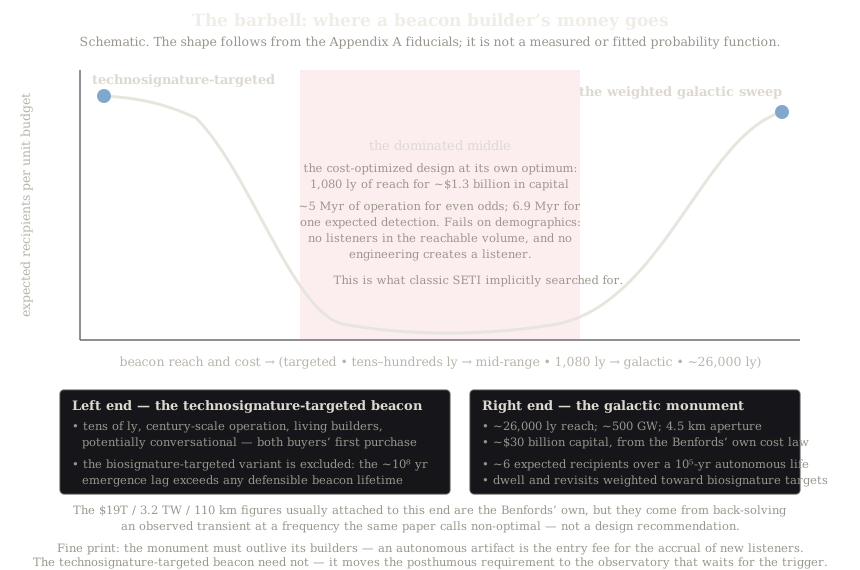
Stand at the top of the ladder with the broadcaster’s figure of merit in hand, and the catalog does not so much rank as allocate. A confirmed technological address is the cheapest recipient money can buy — megawatts against gigawatts, near-certain decoding by an observed listener rather than a hypothetical one — so the first spending goes to a dedicated transmitter on every confirmed technosignature, an outlay capped not by budget but by the catalog, which for any builder at our own observational level is empty or nearly so. Everything after the catalog is exhausted goes to the weighted galactic sweep, the only design that manufactures recipients out of ignorance. The mid-range sweep is dominated at every timescale, and the biosignature-targeted fleet is excluded by the ceiling.
| Capital | Expected recipients | Capital per expected recipient | Reply round trip | |
|---|---|---|---|---|
| Technosignature-targeted | ~MW-scale per target | ~1 per confirmed address | negligible | decades |
| Galactic sweep (weighted, autonomous) | ~$30B | ~6 over a -yr life | ~$5B | ~50,000 yr |
| Mid-range sweep (~1,000 ly) | $1.3B | ~0.02 over the same life | ~$80B | ~2,000+ yr |
| Biosignature-targeted fleet | ≲$5B | ~0 inside the lifetime ceiling | — | — |
Sweeping-row costs are the Benfords’ capital model and extrapolations from it, priced on present-day terrestrial coefficients; recipient counts assume the -year lifetime ceiling and upkeep engineered below the autonomy threshold, and are derived in Appendix A. Targeted-row links are derived in Appendix B. Every entry is a fiducial-scenario value, subject to the Sandberg caveat above.
Plotted against range, the allocation has the shape portfolio theory calls a barbell: the two ends of the design space get the money and the middle gets none, because the middle has neither the reach to brute-force demographics nor the knowledge to escape them.
The Reply-Seeker Runs the Numbers
The second buyer moves through the same catalog much faster, because the reply-seeker discounts, and discounting collapses most of the ladder before the engineering is even consulted. Of the two ways time enters its accounts, the round-trip light lag is the one no design choice can shorten, and at the ranges blind broadcasting requires it is fatal on its own.
A distant reply has no present value
The problem can be dispatched almost immediately for every long-range design. Suppose the nearest plausible recipient is 25,000 light-years away, so a round trip takes 50,000 years. Apply any discount rate at all. Even at one-tenth of one percent per year, an order of magnitude more patient than the most future-oriented rates used in climate economics and far more patient than any human institution has exhibited, a payoff 50,000 years out is discounted by
Multiply by any probability that a reply actually comes and the present value falls below anything an accounting system can represent.
What that establishes is narrow. The full condition for a beacon to repay a reply-seeker is
where is the benefit of a reply — the value, in whatever currency the builder keeps its accounts, of an answer arriving from distance after the round-trip light time , discounted at rate — the probability a reply ever comes, and the last two terms the construction cost and the present value of the operating stream. The calculation above evaluates only the exponential. It says nothing about the size of , the probability that a detected civilization survives and chooses to answer, or the construction and operating costs. What it does establish is that at galactic distances the discount factor alone kills the reply term, whatever the other three are. No blind long-range beacon builder can be an investor expecting a return. Whoever builds one is erecting a monument, discharging a commitment, or leaving an automated artifact behind. None of those motives are predictable from cost-benefit reasoning, which is why economics can constrain the form of a beacon while saying nothing about the rate at which beacons occur. A selection effect follows: if detectable long-range beacons exist, they were built disproportionately by the rare outliers with near-zero time preference. This is why a galactic-scale sweep is a monument and not an investment.
One design survives
Now walk the catalog with the discount factor in hand. Both galactic sweeps, uniform and weighted, founder on the 50,000-year round trip, which no discount rate a living institution has ever exhibited can survive. The mid-range sweep stacks a five-million-year expected wait for detection underneath a two-millennium lag. And anything biosignature-cued fails twice over: the lifetime ceiling already excluded the targeted version for every buyer, and a reply-seeker could not carry the receivable even if the machine could be built, since a conversation whose second party has not evolved yet has no present value at any discount rate. That leaves the technosignature trigger.
The discount factor is fatal because the distance is enormous, and the distance is enormous because a blind broadcaster does not know where anyone is. A builder that has confirmed a recipient is in a different business, and the physics of confirmation forces such a target to be nearby, a few tens of light-years rather than tens of thousands. At thirty-five light-years the round trip is seventy years, and the same tenth-of-a-percent rate that annihilated the galactic case returns 0.93; at a thoroughly human three percent the reply retains twelve percent of its face value. Twenty-one orders of magnitude separate the two cases, and the difference is bought by knowing who you are talking to.
So the reply-seeker has almost no shopping to do. The technosignature-targeted beacon — the same transmitter the broadcaster parks on a confirmed address, down to the laser — is the only design in this catalog with plausible positive net present value to a builder who expects an answer, and it is aimed, necessarily, at a neighbor.
The return envelope
The surviving design’s message writes itself, and it is not the encyclopedia. Every year the target spends decoding a library before noticing the invitation is a year of round trip lost, so the reply-seeker fronts an uplink specification — reply here, in this format, this power will suffice, we are listening — with the echo as letterhead: the target’s own earliest broadcasts, returned, arriving at twice the light-travel time from their emission, authentication and address in a single gesture that no shared convention has to carry. The library, if the builder sends one at all, rides behind the envelope, never in front of it.
The patient outlier
One conditional entry deserves to be granted rather than ruled out. The demographic wall that killed the mid-range sweep is built from fiducials, and Appendix A’s own sensitivity analysis names the breach: raise the civilization formation rate by two orders of magnitude and the middle of the barbell becomes viable on its own. A reply-seeker in that galaxy — one where the nearest listener plausibly sits within a few hundred light-years — could rationally build a short-to-mid-range sweeping beacon, provided it also holds the other dial at its edge, since round trips at those ranges run from centuries to millennia and demand discount rates no human institution has exhibited. Both conditions are grants, not estimates. Inside the carve-out the sweep’s rules still apply — biosignature worlds earn premium dwell, never a dedicated transmitter, on the same calendar arithmetic as ever — and the entry is best read as a boundary marker: a reply-seeker patient enough, in a galaxy crowded enough, shades into a broadcaster.
The Probe Against the Beacon
Everything above assumes the message travels as light. It has one rival vehicle, and the rivalry is as old as the field: within a year of Cocconi and Morrison, Ronald Bracewell replied in the same journal that a superior civilization would not bother with beacons at all — it would send automated messenger probes to likely nearby systems and let them do the waiting.24 The proposal is periodically rediscovered, most recently by Zuckerman, whose communicative civilization sends probes as readily as transmissions and who reads the absence of any probe in Earth orbit as a constraint on the number of communicators in the galaxy.11 The catalog is not closed until the probe has been priced for both buyers.
For the reply-seeker the pricing is immediate, because the probe attacks the one term no vehicle can improve. Information moves at whatever carries it, so the beacon’s round trip of is a floor for every architecture; a probe can only add to it, and at one percent of lightspeed the addition is a hundred times in transit before the conversation can begin — fifty full round trips of delay, applied to a discount factor that was already fatal at one. The probe-as-relay does buy one real thing: a relay listening from inside the target system deletes the target’s uplink burden, since a civilization that can hear a beacon may not be able to answer at interstellar effective powers, and raising is worth money. But the builder’s own receiving aperture buys the same thing from home — the return envelope’s this power will suffice, we are listening — at a fraction of the cost and none of the transit. And the emissary version, a mind aboard the probe conducting the conversation locally at full bandwidth, does not defeat the objection so much as exit the buyer class: a builder content with a conversation its emissary has, to be reported home a round trip later if ever, was never buying an answer within a time span that mattered to it. There is no probe row for the reply-seeker, and the reason is the same discount factor that emptied the rest of its catalog.
The broadcaster’s ledger reads differently, because the broadcaster does not discount. Transit time is free to a buyer who counts a recipient in three thousand years at par with one tomorrow, and so is the light-lagged replacement of a failed probe; risk enters as a multiplier on expected cost per recipient, not as a timing objection. And the entries on the probe’s side of the ledger are strong on precisely the axes this piece has cared most about. Delivery: a probe in-system transmits at local link budgets, persistently and re-observably, and it runs the echo strategy at its logical limit, composing the library in the target’s own demonstrated conventions from broadcasts intercepted at one astronomical unit — the pedagogy bill goes to zero. Authentication: the five-rung ladder that every beacon climbs by likelihood ratio, a physical artifact climbs in one move, because an object that can be ranged, imaged, and eventually inspected settles artificiality by engineering forensics; the confirmation crisis that dominates both sweeping designs simply does not exist for a machine that stays where it was found. If probes sold at beacon prices, the broadcaster would buy them.
Three things stand between the broadcaster and the purchase. The first is a timing mismatch that degrades the obvious design. A probe cued by a technosignature — the analog of the catalog’s best beacon — launches toward an observed civilization and arrives at an unobserved one: the conspicuous window runs a century or two, the transit runs three hundred and fifty years at a tenth of lightspeed and three thousand five hundred at a hundredth, and the stopping rule that made the triggered beacon graceful is unavailable to hardware in flight. The cue expires before the vehicle arrives, and the design collapses into its second form. That form — Bracewell’s actual proposal — is the strong one: park the probe at a biosignature world, dormant, watching from inside the system, and let it answer the target’s technological onset locally, with a response lag of years instead of . This deletes, at a stroke, both weak joints of the technosignature-targeted beacon: the handshake radius, because onset detection at one astronomical unit needs no interstellar sensitivity, and the geological-timescale monitoring observatory, because the watching rides along. What it costs is the wait, and the wait is the emergence lag. The park-and-wait probe must survive on station for the same years that excluded the biosignature-targeted beacon, and the lifetime ceiling does not care that dormancy is cheaper than transmission — it forbids the hardware. The Bracewell probe is the biosignature-targeted beacon’s physical twin, excluded on the identical dial, and it is no coincidence that Zuckerman’s probe argument and his transmitter fleet share the same billion-year civilization: both revive together under his anchor, and both die together under this one.
The second obstacle is that the probe cannot be priced at all under this piece’s own discipline. Every number in the catalog above is anchored to present terrestrial coefficients — that anchoring is what makes the Benford figures mean something — and on present coefficients an interstellar probe that decelerates, inserts into orbit, and survives millennia on station prices not at some large figure but at cannot be built: the costed concepts that exist are gram-scale flybys, and deceleration alone has no credible engineering, a point Zuckerman’s own paper concedes. So the probe row’s entry is a different kind of object from the rows around it — excluded at present coefficients, reviving under exactly the technological generosity that revives the ceiling-breakers — and honesty requires saying so rather than inventing a dollar figure.
The third is the first impression. A beacon reveals its builder’s existence and position while keeping it demonstrably tens of light-years away; a probe is uninvited physical presence, its dual-use survey function is surveillance read uncharitably, and the artifact itself leaks what no transmission does, since a machine that can be captured discloses its builder’s technological level to whoever captures it. A dormant probe discovered before it announces itself is close to the worst first impression a broadcaster can make. The dark-forest argument, which the monument section priced as a filter on who builds rather than a veto on whether anyone does, cuts harder here than anywhere in the catalog — physical presence in the target’s system is the one move that looks hostile even to a target inclined to charity.
What survives is the entry nobody has to buy. If science probes get sent at all — and survey astronomy funds itself on its own merits, as this piece has assumed throughout — then the marginal cost of a message payload is negligible, and the existence proof is on our own ledger: the Voyager record is a broadcast riding a science probe, purchased for approximately nothing, optimized for nothing.25 The realistic probe-broadcaster is not a buyer choosing probes over beacons but a commensal rider on trajectories the science budget chose, which carries a search-side corollary: the selection function of any probes worth expecting is their builders’ astronomy, not their builders’ message. And the same result runs Zuckerman’s inference in reverse. An upper limit on galactic communicators derived from the absence of probes in Earth orbit requires probe-sending to be the dominant strategy of communicative civilizations, and on this catalog it is a niche buy — dominated for one buyer, unpriceable for the other, its best version contingent on the same contested ceiling as the transmitter fleet it accompanies. The absence of probes constrains the ceiling-breakers, not the communicators — and that is before asking whether a dormant, cosmically old, meter-scale artifact in cislunar space is something our surveys could actually have excluded, which nobody has established.
Conclusion
The narrowed thesis is this. Beacon design is downstream of motive first and knowledge second, and two motives exhaust the catalog. A message broadcaster’s money goes first to any confirmed technological address and then to a galaxy-scale weighted sweep — autonomous because the operating arithmetic forbids anything else, long-lived because longevity is the cheapest recipient multiplier on sale, its schedule and pulse structure carrying a message layered in bits where the hardware is priced in watts: a self-describing pulse train, an announced schedule, a dense layer delivering the letter to whoever keeps the appointment. A reply-seeker has no choices at all: only the technosignature-triggered targeted beacon avoids both the timing objection and the demographic objection to a conversation its living builders could see completed. It is aimed at a conspicuous neighbor, runs for a century instead of a hundred million years, opens with an echo of the neighbor’s own broadcasts returned in the neighbor’s own bands, carries its own proof of artificiality, and under the link budget in Appendix B is at least as likely to be a laser as a radio carrier. Schwartz and Townes, filed away in 1961 as a curiosity of instrument history, described its likeliest form two years after the field was founded, and Townes returned in 1983 to argue that the case had if anything moved further into the infrared — where, for the M dwarfs that dominate any real target list, the target’s own planet-hunting spectrographs now sit. And the middle of the design space — the moderate, continuous, guessable beacon SETI implicitly hunted for sixty-five years — serves neither motive: too short-ranged to manufacture recipients, too slow to promise a reply, funded by no one. The one vehicle other than light adds no third motive and no surviving design of its own: the probe is dominated for the reply-seeker, unpriceable for the broadcaster, its strongest version the physical twin of the biosignature beacon the lifetime ceiling already excluded, and its realistic version a message riding commensally on someone’s science budget.
The Wow! printout reads differently under this framework than it did in 1977. It is either nature being briefly loud at the one frequency the founders assumed nature kept quiet, or a sweeping beacon that failed its own design review: bright enough to be noticed once, structured enough to prove nothing, timed to no convention anyone had registered.
That printout is where this series goes next. This piece ran a design review on the transmitters; the sequels run the same review on the search, one surviving beacon class at a time. Part 2: Who Can See Us? tackles the targeted beacon: it audits sixty-five years of search strategy against the technosignature-targeted design and lays out what a program built deliberately for them would look like — how much of it is scheduling, reprocessing, and pipeline changes rather than new telescopes, and where it should point first. Part 3: Looking Afar does the same for the galactic monument: how much of the historical record could have caught a brief broadband flash sweeping past once a year, and what a search designed to catch — and confirm — one requires.
Appendix A: The Beacon Arithmetic
The detection equation
The Drake equation cannot be used directly for beacon searches, because its later terms fold in detectability and civilization lifetime, and beacon lifetime decouples from civilization lifetime in both directions: an automated beacon can outlive its builders, and a civilization can transmit for a century out of a hundred-millennium existence. Truncate the Drake chain at the emergence of intelligence to obtain a formation rate, then rebuild:
where is the fraction of civilizations that ever build a beacon, the mean number each builds, and the mean beacon operating lifetime. is the number currently radiating in the galaxy. Coupling to a search:
with the fraction of beacons within range, the probability the beacon illuminates us while we observe, and the fractions of sky, frequency space, and signal-morphology space the search covers. The Poisson form handles correctly and exposes a ceiling: with every coverage term saturated at unity, , so a complete search of the entire galaxy can still fail and nothing buildable changes that. Claudio Grimaldi’s signal-coverage models develop the same point rigorously, showing that the mean number of detectable emitters can remain below one across broad parameter ranges regardless of how many emitters the galaxy contains.26
Worked example with generous fiducials: per year galaxy-wide, , , years, giving . Coupling terms representative of current practice, for an SKA-class receiver against a W transmitter, , , , , yield .
The main text uses two supplementary results. The beaming cancellation, in the disk regime. And the confirmation penalty: for Poisson catches with small mean , the probability of the two detections that belief requires is
so every unfavorable factor in the chain is doubled in its exponent, and every order of magnitude of search capability purchases two orders of magnitude of confirmed-detection probability.
The barbell arithmetic
The operating lifetimes quoted for the sweeping designs come from running this chain at their respective scales. Take per year galaxy-wide, a galactic-disk volume cubic parsecs, a listening lifetime years per civilization, and a coupling factor for the chance that an in-range listener’s sky, frequency and morphology coverage catches the beacon. New listeners arise within range at , and the standing population at switch-on is that rate times . Setting the standing population to one and solving for volume gives , the half-the-disk threshold quoted in the main text.
The cost-optimized column is the Benfords’ own “Short-Pulse Medium-Range” table entry: 1,080 light-year range, W EIRP, 21.9 GW optimum power, 0.91 km aperture, $1.3 billion total capital, at $0.03/W pulsed and $1k/m² aperture.8 The monument column is derived here by pushing their cost law, , out to galactic-center range. Because , cost and optimum power scale as and optimum diameter as , so their 10,800-light-year, $13.1 billion entry becomes roughly $30 billion, 500 GW and 4.5 km at 26,000 light-years.
Both columns carry provenance caveats. The widely-quoted 3.2 TW / 110 km / $19 trillion figures are the Benfords’ own, but they back-solve the observed transient GCRT J1745-3009 using continuous-power cost coefficients; they are neither a design recommendation nor the cost-optimum at that range.9 And the cost model is calibrated on present-day terrestrial power and aperture prices — defensible, since the optimum depends only on the ratio of the cost exponents, but still conditional on human cost curves rather than a law of alien industrial economics.
Detection probability is Poisson, so even odds occur at , not at . The table gives both, because the two are routinely conflated and they differ by a factor of 1.44 in required operating life.
| Cost-optimized | Galactic monument | |
|---|---|---|
| Capital cost | $1.3B | ~$30B |
| Optimum power / aperture | 21.9 GW / 0.91 km | ~500 GW / ~4.5 km |
| Range | 1,080 ly (331 pc) | ~26,000 ly (7,970 pc) |
| Volume reached | 1.5×10⁸ pc³ | 6.0×10¹⁰ pc³ (29% of disk) |
| New civilizations in range | 1 per 691,000 yr | 1 per 1,750 yr |
| Standing listeners at switch-on, λ₀ | 0.0014 | 0.57 |
| P(detected) at switch-on | 0.14% | 43% |
| Operating life for 50%, λ = ln 2 | ~4.8 Myr | ~2,100 yr |
| Operating life for λ = 1 | ~6.9 Myr | ~7,500 yr |
| P(detected) after 10⁴ yr | 0.29% | 68% |
| Operations at 10% of capital / yr | ~$0.13B/yr | ~$3B/yr |
| Expected total cost to even odds | ~$600T | ~$6T |
| Expected total cost to λ = 1 | ~$900T | ~$23T |
The mid-range volume is taken as a sphere and the monument’s as a 300 pc slab through the disk, which is where the transition between the two regimes falls. The mid-range design must operate for nearly five million years to reach even odds, while the monument starts life close to the halfway mark for twenty-three times the capital. Everything separating the two columns is demographics.
The last three rows price those lifetimes using the model’s own operating rule of roughly 10% of capital per year. Two things fall out of them. The capital comparison inverts, the monument going from twenty-three times dearer to roughly a hundred times cheaper, because nearly all of the expected cost of either design is the wait rather than the hardware. And the literature’s $19 trillion “megastructure” figure, wrong as a capital cost by a factor of about six hundred, lands close to the monument’s actual lifetime bill to one expected detection — the right order of magnitude attached to the wrong line item.
The columns are sensitive to three inputs. Raising from to years multiplies both standing populations by ten, taking the monument to near-certainty at switch-on and the cost-optimized design to a 1% chance; dropping it to years pushes the monument’s even-odds lifetime out past twenty thousand years; and raising by two orders of magnitude makes the middle of the barbell viable on its own. The expected-total-cost rows inherit this sensitivity linearly, since they are the even-odds and λ = 1 lifetimes priced at a fixed annual rate. The barbell shape is a result about these fiducials and not a proof of formal domination across every budget and utility function.
The range-versus-lifetime split
The main text’s claim that autonomy is the sweep’s entry fee comes from here. Give a broadcaster a fixed budget , split between capital , which buys range, and upkeep at a fraction of capital per year, which buys operating life , so that . In the slab regime footprint volume grows as the square of range and the Benford cost law prices range linearly in capital, so , and expected recipients are the standing population plus the accrual:
Maximizing over the split turns on the product . Above the optimum is a corner — all budget to capital, maximum range, a run no longer than confirmation demands, the squared confirmation penalty setting that floor at tens of revisit periods — because a year of upkeep buys fewer recipients than the same money spent on footprint. Below it an interior optimum appears and moves outward as falls, reaching the lifetime ceiling with once . With the fiducial years the crossover sits at per year, and the terrestrial coefficient of 0.1 is more than three orders of magnitude above it: a builder paying human operating costs is forced into the build-big-sweep-briefly corner, capped at the standing population, and a builder who wants the accrual must engineer upkeep down to a few thousandths of a percent of capital per year, which is what “autonomous artifact” means as a line item.
The accrual is worth the engineering. At the ceiling, the monument adds recipients at per year — the one-per-1,750-year formation rate inside its footprint times the coupling factor — for years, about 5.7 on top of the 0.57 standing at switch-on: six expected recipients, near $5 billion of capital each. The mid-range design over the identical interval accumulates about 0.016, near $80 billion of capital per recipient. The barbell holds under the recipient metric by roughly the margins it held under detections, with one addition: under institutional upkeep neither design escapes the corner, and the corner’s recipients are the standing populations alone, 0.57 against 0.0014 — the same barbell, steeper.
The response equation
A technosignature-triggered beacon replaces the galaxy-wide beacon count with a local one. Inside the handshake radius defined in the main text, the expected number of responses to a conspicuous target is
with in civilizations per cubic parsec, or equivalently in per-star form,
with the fraction of stars hosting a contemporaneous technological civilization, the fraction with instruments able to read the target’s technosignature at range, and the fraction that act on it. The two forms must not be mixed; the earlier draft of this argument multiplied a volume by a per-star density and was wrong by the local stellar density.
The radius entering the equation is and not , so the detectability cap is retained. Where the time term binds, grows as the cube of the target’s technosignature lifetime, the steepest dependence anywhere in the chain and the reason technosignature duration deserves the attention Garrett has urged for it.27 Where the detection cap binds, the cube law switches off and the count is fixed by the observer’s telescope.
Run in per-star form with a generous fiducial, from a standing population of order twenty technological civilizations across stars, roughly 500 stellar systems within forty light-years, and , the expected number of responses to Earth is about , against for the entire current search program. Setting both fractions to one is not a defensible estimate; it is the ceiling, and any real value is below it.
The difference between the two is the anatomy, not the magnitude. In the general case the loss is dominated by , and , terms that are ours to spend on. Inside the response sphere all of those can be driven to unity for the price of a catalog query and some bandwidth, and what remains is demographic.
The orders-of-magnitude ledger
Two answers to “how much more searching would reasonable odds require.” The main text quotes both; this is where they come from.
Conditional on a beacon model, with transmitters roughly where the barbell predicts, at powers plausible for their class, in the galactic disk, the detection equation sits 7.3 orders of magnitude short of an expected detection of one. Full saturation of every coupling term supplies 8.6 orders and would raise the expectation to the assumed underlying beacon count of about twenty. The 8.6 decomposes into roughly 3.0 orders in sky coverage, 1.2 in temporal coverage, 1.0 in frequency coverage, 1.0 in signal-morphology assumptions, and 2.4 in raw sensitivity.
The first four are purchasable with architecture and computation instead of steel: wide-field staring arrays, wideband digitizers, pipelines that admit pulsed and broadband morphologies. The morphology term is close to free, being reprocessing of archived data, and wide-field instruments have already demonstrated order-of-magnitude jumps in searched volume per campaign.28 The sensitivity term is the brutal one, because collecting area buys detection volume only linearly in the disk regime, receives no help from Moore’s law, and costs at the scale of hundreds of billions of dollars. The main text’s claim that the loss occurs in terms the receiver controls covers the first four terms and not the range term, unless one is prepared to treat a 2.4-dex sensitivity expansion as purchasable. Even then, tiling the full sky at high sensitivity multiplies beams by channels into a processing problem of order spectral products, so the binding constraint on a fully scaled search is the correlator and not the dish.
Against the broad fiducial radio haystack, the collective historical effort stands at searched, about 17.2 orders of magnitude from that haystack’s defined completeness, and that figure is not achievable by anything.29 The 9.9-order difference between the two answers is purchased entirely by willingness to assume a transmitter model, which is the arithmetic behind the main text’s claim that the gap is closed by conviction rather than by construction. The binding scarcity in SETI is not collecting area but the courage of one’s assumptions, and the obligation to state them.
Both ledgers are priced in radio. The optical channel scarcely appears in either, since the haystack was defined over radio SETI programs and the frequency-coverage headroom assumes a receiver that must tune. For the targeted class the laser-line channel barely needs a ledger, because a single high-resolution exposure drives the frequency-coverage term to unity across that setting’s band, and many of the exposures already exist in planet hunters’ archives.
Appendix B: The Link Budget
Every waveband conclusion in the main text rests on this calculation. It is derived here rather than cited, and it is reproducible from the stated inputs. All figures assume a diffraction-limited circular aperture with at aperture efficiency , free-space propagation with no interstellar attenuation, perfect pointing, and a receiver at the diffraction-limited beam center.
Radio
| Quantity | Value |
|---|---|
| Frequency / wavelength | 1.42 GHz / 0.211 m |
| Transmitter aperture | 100 m |
| Aperture efficiency | 0.6 |
| Gain | (61 dBi) |
| Physical radiated power | W |
| EIRP | W |
| Reference receiver | GBT, 15-min integration, Breakthrough Listen pipeline |
| Receiver EIRP limit at 50 pc | W30 |
The reference sensitivity is Price et al.’s published minimum detectable EIRP of W at the 50 pc edge of the Breakthrough Listen nearby-star sample.30 That is the Green Bank figure; the same paper reports W for Parkes, which alone carries the far-southern sky Green Bank cannot point at, so every margin below shrinks by a factor of 4.3 on Parkes-only targets. EIRP scales as , so the Green Bank pipeline requires W at 100 pc, which is where the W per-target figure comes from. Inverting, a W transmitter is detectable by that pipeline at 125 pc, with a margin over the published limit of 320 at 20 ly and 51 at 50 ly — 74 and 12 on the Parkes anchor, an exclusion still, but a thinner one. Those numbers support the claim that existing integrations already exclude a fiducial targeted beacon inside a few tens of light-years, and they are sensitive to everything in the table above: halve the transmitter aperture and the margin drops by four. What the margins do not carry is band coverage — a receiver can be sensitive enough and tuned elsewhere, and which stars were ever observed in the predicted band is a separate question, audited in Part 2.
Optical and near-infrared
The one-micron fiducial below is near-infrared rather than visible, and the reason needs stating carefully, because the physics alone does not supply it. Short wavelength buys gain, which is pure profit for a starer, and against an M-dwarf host the contrast improves toward the blue as well, since a 3,000 K photosphere falls away toward the visible far faster than the gain grows; left to the link budget, the builder would go bluer than a micron. What anchors the design at one to two microns is the target’s instrument inventory. The discovery mechanism this class leans on is the target’s own precision radial-velocity program, and for M dwarfs that program works in the near-infrared — CARMENES spanning 0.52–1.71 μm across its two channels, SPIRou at 0.98–2.35 μm, NIRPS at 0.98–1.80 μm, the Habitable-zone Planet Finder at 0.81–1.28 μm — at R between 55,000 and 100,000, the resolving power the contrast calculation below assumes.22 A visible-band laser from a late M dwarf would stand higher above its host’s continuum and land in exposures nobody takes, because visible spectra of faint red stars are photon-starved and the surveys skip them. The band tracks the archive, not the optimum — which also makes the choice conditional on the builder’s host: a builder around an FGK star, already covered in quantity by the target’s visible spectrographs, runs the identical argument to the visible, and the one-micron fiducial describes the M-dwarf hosts that dominate the nearby census.
Going the other way, into the mid-infrared, fails three times over, and the first failure is worth working because the standard argument for the band overstates itself. The claim is that line-to-continuum contrast improves toward long wavelength: at fixed resolving power a resolution element’s width scales as frequency while a Rayleigh–Jeans continuum scales as frequency squared, so the stellar continuum in one element goes as the cube while the received laser flux goes only as the square, and contrast improves linearly in wavelength. The scaling is right and the premise is not, because no plausible host is in the Rayleigh–Jeans regime at one micron. Run with the full Planck function, the contrast gained between one micron and ten is a factor of about 2.5 for a solar-type host, and for an M dwarf, whose spectrum peaks near one micron, the move makes contrast worse; either way it is dwarfed by the hundredfold gain surrendered at the same step. The second failure is thermal background, since at ten microns the sky, the atmosphere, the telescope and the zodiacal dust all radiate into the band at a few hundred kelvin; Townes’ 1983 argument that the infrared beats the microwave region on required power assumed ideal heterodyne detection and does not survive a warm receiver on a cloudy planet.6 The third is the instrument inventory: the mid-infrared has no analogue of the radial-velocity fleet. High-resolution instruments exist there — TEXES on the IRTF reaches R ≈ 100,000 across 4.5–25 μm, and EXES flew the same regime on SOFIA until its retirement31 — but they are niche spectrographs that have never surveyed nearby stars, and the general-purpose workhorse, JWST’s MIRI, tops out near R ≈ 3,000. The discovery mechanism this whole design leans on — a beacon falling unlooked-for into spectra the target takes for its own reasons — has no mid-infrared realization to lean on.
| Quantity | Value |
|---|---|
| Wavelength | 1 μm |
| Transmitter aperture | 10 m |
| Gain | |
| Physical radiated power | W |
| EIRP | W |
| Beam width | rad = 0.27 AU at 35 ly |
| Transmitted linewidth | Hz-class for a stabilized oscillator |
| Receiver | R = 100,000 spectrograph, resolution element 3 GHz at 1 μm |
| Host star | G2V, solar luminosity, 35 ly |
Received laser flux at 35 ly ( m) is W m⁻², against a stellar bolometric flux at the same distance of W m⁻². Solar spectral irradiance near 1 μm is about of the bolometric total per nanometer, and an R = 100,000 element at 1 μm is 0.01 nm wide, so the stellar continuum in one resolution element is W m⁻². The line-to-continuum ratio is therefore about 3, which is what “several times brighter than the continuum in one channel” means and all it means. Against an M5V host the same laser sits two to three orders of magnitude above the continuum in that element.
Two limits follow from the resolution number. An R = 100,000 element is 3 GHz wide, so a hertz-class transmitted line is unresolved: the spectrograph sees an excess in a single element and cannot measure the line’s width. Establishing that the width sits below the natural maser and laser floors, which is the internal-structure authentication channel, requires a heterodyne or Fabry–Pérot follow-up and is not a product of ordinary high-resolution spectroscopy. And a spectrograph covers the band of its current setting in one exposure, not the optical spectrum, with detector gaps, telluric absorption, and wavelength-dependent throughput between the beacon and the detection.
What is not in the budget
Pointing and ephemeris error, interstellar extinction and scattering at optical, atmospheric transmission at the receiver, receiver quantum efficiency, and the transmitter’s wall-plug efficiency are all set aside. Each costs the link margin, none changes the radio-versus-optical comparison by the ten orders of magnitude that separate the two gains, and a serious design study would have to carry all of them. What the budget supports is equal weighting of the laser and radio channels when a targeted search is designed. It does not support the claim that economics uniquely selects optical.
References
Footnotes
-
Ehman, J. R., “The Big Ear Wow! Signal: What We Know and Don’t Know About It After 20 Years,” 1997; see also Gray, R., The Elusive Wow, 2012. http://www.bigear.org/wow20th.htm ↩
-
Dick, S. J., The Biological Universe: The Twentieth-Century Extraterrestrial Life Debate and the Limits of Science, Cambridge University Press, 1996, ch. 8, on the Tesla and Marconi claims and the 1924 radio silence. ↩
-
Cocconi, G. & Morrison, P., “Searching for Interstellar Communications,” Nature 184, 844–846, 1959. https://www.nature.com/articles/184844a0 ↩
-
Oliver, B. M. & Billingham, J. (eds.), “Project Cyclops: A Design Study of a System for Detecting Extraterrestrial Intelligent Life,” NASA CR-114445, 1971. ↩
-
Schwartz, R. N. & Townes, C. H., “Interstellar and Interplanetary Communication by Optical Masers,” Nature 190, 205–208, 1961. https://www.nature.com/articles/190205a0 ↩
-
Townes, C. H., “At What Wavelengths Should We Search for Signals from Extraterrestrial Intelligence?,” PNAS 80(4), 1147–1151, 1983. https://www.pnas.org/doi/10.1073/pnas.80.4.1147 ↩ ↩2
-
Howard, A. W. et al., “Search for Nanosecond Optical Pulses from Nearby Solar-Type Stars,” Astrophysical Journal 613, 1270–1284, 2004. https://iopscience.iop.org/article/10.1086/423300 ↩
-
Benford, J., Benford, G. & Benford, D., “Messaging with Cost-Optimized Interstellar Beacons,” Astrobiology 10(5), 475–490, 2010. https://arxiv.org/abs/0810.3964 ↩ ↩2 ↩3
-
Benford, G., Benford, J. & Benford, D., “Searching for Cost-Optimized Interstellar Beacons,” Astrobiology 10(5), 491–498, 2010. https://arxiv.org/abs/0810.3966 ↩ ↩2 ↩3
-
Billingham and Benford, arguing against METI, observe that if all a transmission can achieve at interstellar range is being noticed, “it would be more efficient to transmit a simple sine wave” (JBIS 67, 22, 2014, https://arxiv.org/abs/1102.1938). Often read as a beacon design principle, the line is a critique of sending messages nobody can decode; the Benfords’ cost-optimization papers conclude the opposite for beacons — a broadband pulse train carrying coded pointers to a higher-content signal. ↩
-
Zuckerman, B., “Broadband Searches for Extraterrestrial Technological Intelligence: A New Strategy to Find Nearby Alien Civilizations,” ApJ 1001, 167, 2026. https://arxiv.org/abs/2603.07333 ↩ ↩2
-
Billingham, J. & Benford, J., “Costs and Difficulties of Large-Scale ‘Messaging’, and the Need for International Debate on Potential Risks,” JBIS 67, 22, 2014. https://arxiv.org/abs/1102.1938 ↩
-
Sandberg, A., Drexler, E. & Ord, T., “Dissolving the Fermi Paradox,” arXiv preprint, 2018. https://arxiv.org/abs/1806.02404 ↩
-
Draine, B. T., “Interstellar Dust Grains,” Annual Review of Astronomy and Astrophysics 41, 241–289, 2003. https://arxiv.org/abs/astro-ph/0304489 ↩
-
Nishiyama, S. et al., “The Interstellar Extinction Law toward the Galactic Center II: V, J, H, and Ks Bands,” Astrophysical Journal 680, 1174–1179, 2008. https://arxiv.org/abs/0802.3559 — see also Nishiyama et al., ”…III: J, H, Ks Bands and 3.6, 4.5, 5.8, 8.0 μm in the Spitzer/IRAC System,” ApJ 696, 1407, 2009, https://iopscience.iop.org/article/10.1088/0004-637X/696/2/1407, which extends the flattening of the law into the mid-infrared. ↩
-
Davenport, J. R. A. et al., “Searching the SETI Ellipsoid with Gaia,” Astronomical Journal 164, 117, 2022. https://iopscience.iop.org/article/10.3847/1538-3881/ac82ea ↩
-
Kaltenegger, L. & Faherty, J. K., “Past, Present and Future Stars That Can See Earth as a Transiting Exoplanet,” Nature 594, 505–507, 2021. https://www.nature.com/articles/s41586-021-03596-y ↩
-
Lyons, T. W., Reinhard, C. T. & Planavsky, N. J., “The Rise of Oxygen in Earth’s Early Ocean and Atmosphere,” Nature 506, 307–315, 2014. https://www.nature.com/articles/nature13068 ↩
-
Wandel, A., “The Fermi Paradox Revisited: Technosignatures and the Contact Era,” ApJ 941, 184, 2022. https://arxiv.org/abs/2211.16505 ↩
-
Kerins, E., “Mutual Detectability: A Targeted SETI Strategy That Avoids the SETI Paradox,” Astronomical Journal 161, 39, 2021. https://arxiv.org/abs/2010.04089 ↩
-
Lin, H. W., Gonzalez Abad, G. & Loeb, A., “Detecting Industrial Pollution in the Atmospheres of Earth-like Exoplanets,” ApJL 792, L7, 2014. https://arxiv.org/abs/1406.3025 ↩
-
Instrument ranges and resolving powers: CARMENES, 0.52–0.96 μm (VIS) and 0.96–1.71 μm (NIR) at R ≈ 94,600 and 80,400; SPIRou, 0.98–2.35 μm at R ≈ 70,000; NIRPS, 0.98–1.80 μm at R ≥ 80,000, https://www.eso.org/sci/facilities/develop/instruments/NIRPS.html; the Habitable-zone Planet Finder, 0.81–1.28 μm at R ≈ 55,000, https://arxiv.org/abs/1408.3632. All four were built to chase planets around M dwarfs, which is why they sit where they sit. ↩ ↩2
-
Freudenthal, H., Lincos: Design of a Language for Cosmic Intercourse, Part I, North-Holland, 1960. ↩
-
Bracewell, R. N., “Communications from Superior Galactic Communities,” Nature 186, 670–671, 1960. https://www.nature.com/articles/186670a0 ↩
-
Sagan, C., Drake, F. D., Druyan, A., Ferris, T., Lomberg, J. & Sagan, L. S., Murmurs of Earth: The Voyager Interstellar Record, Random House, 1978. ↩
-
Grimaldi, C., “Signal Coverage Approach to the Detection Probability of Hypothetical Extraterrestrial Emitters in the Milky Way,” Scientific Reports 7, 46273, 2017. https://www.nature.com/articles/srep46273 ↩
-
Garrett, M. A., “SETI’s Blind Spot: Technological Acceleration and Fleeting Technosignatures,” IAU Symp. 404, 2026. https://arxiv.org/abs/2607.07413 ↩
-
Tremblay, C. D. & Tingay, S. J., “A SETI Survey of the Vela Region Using the Murchison Widefield Array,” PASA 37, e035, 2020. https://arxiv.org/abs/2009.03267 ↩
-
Wright, J. T., Kanodia, S. & Lubar, E., “How Much SETI Has Been Done? Finding Needles in the n-Dimensional Cosmic Haystack,” Astronomical Journal 156, 260, 2018. https://arxiv.org/abs/1809.07252 ↩
-
Price, D. C. et al., “The Breakthrough Listen Search for Intelligent Life: Observations of 1327 Nearby Stars Over 1.10–3.45 GHz,” Astronomical Journal 159, 86, 2020. https://arxiv.org/abs/1906.07750 ↩ ↩2
-
Lacy, J. H. et al., “TEXES: A Sensitive High-Resolution Grating Spectrograph for the Mid-Infrared,” PASP 114, 153–168, 2002. https://arxiv.org/abs/astro-ph/0110521 — R up to ≈ 100,000 across 4.5–25 μm. The airborne counterpart is EXES, R up to ≈ 112,000 at 4.5–28.3 μm, which flew on SOFIA until the observatory’s 2022 retirement: Richter, M. J. et al., Journal of Astronomical Instrumentation 7, 1840013, 2018. ↩
This article represents my personal opinions and research. Nothing in this article should be taken as professional, financial, legal, or investment advice.